

Work
areas
We work across three thematic areas that address key climate change challenges for Latin America and the world. Each combines research and analysis to understand current challenges and provide tools for climate action.
How do we organize
our work?
Our thematic approach is organized around three pillars that interact constantly. We understand that a just energy transition is not possible without adequate public policies, nor are sustainable policies possible without social justice on the ground.
For this reason, we promote cross-cutting work in which each thematic area informs the others, producing comprehensive, actionable recommendations for the Latin American and international context.

Cross-cutting considerations


You may also be interested
GoGoGo to publications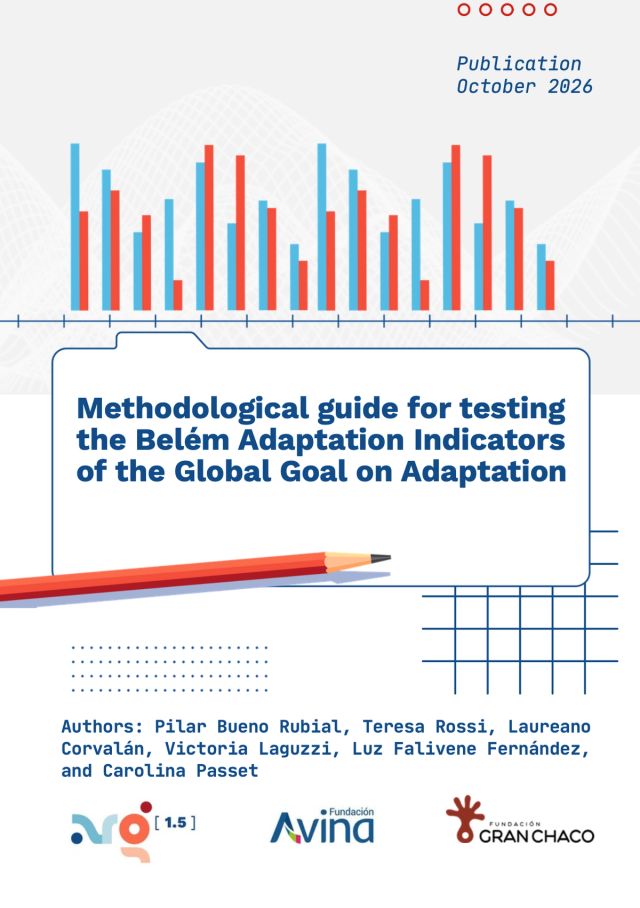
Methodological guide for testing the Belém Adaptation Indicators of the Global Goal on Adaptation
This guide was developed by Fundación Argentina 1.5 and Fundación Gran Chaco, with the support of Fundación Avina, combining the organizations' experiences with multi-level adaptation actions and drawing upon a pilot exercise conducted in the province of Chaco, Argentina. The guide aims to contribute to the global effort to pilot the Belém Adaptation Indicators by offering a practical perspective based on 11 interviews with representatives from countries, country groups, and organizations that generously shared their processes, challenges, and expectations.
Methodological guide for testing the Belém Adaptation Indicators of the Global Goal on Adaptation
This guide was developed by Fundación Argentina 1.5 and Fundación Gran Chaco, with the support of Fundación Avina, combining the organizations' experiences with multi-level adaptation actions and drawing upon a pilot exercise conducted in the province of Chaco, Argentina. The guide aims to contribute to the global effort to pilot the Belém Adaptation Indicators by offering a practical perspective based on 11 interviews with representatives from countries, country groups, and organizations that generously shared their processes, challenges, and expectations.
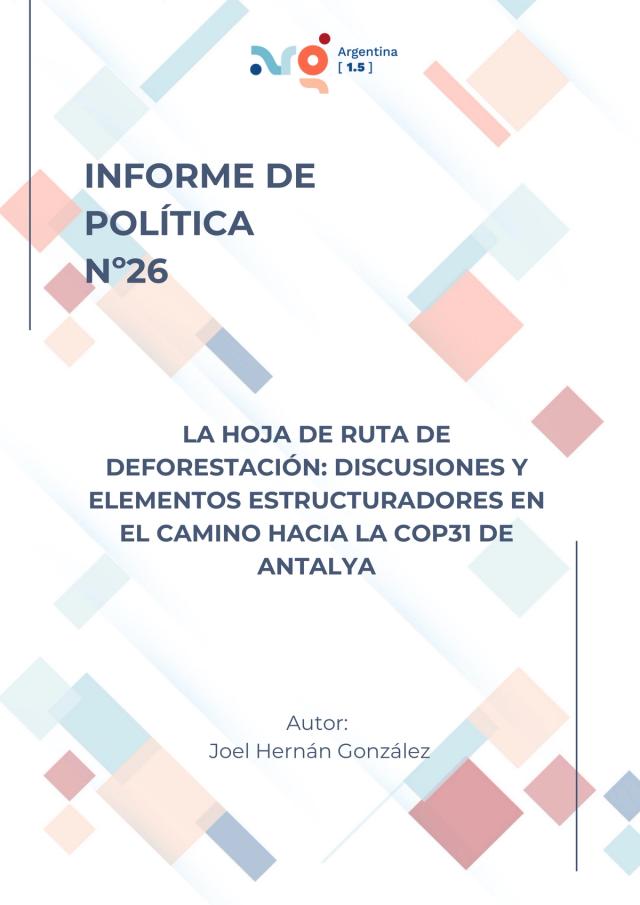
Deforestation Roadmap: discussions and structuring elements on the road to COP31 in Antalya
Forests provide essential ecosystem services for addressing the global environmental and climate crisis. Their capacity to store carbon, regulate hydrological cycles, stabilize regional temperatures, conserve biodiversity, and sustain the livelihoods of millions of people makes them a central component of international mitigation and adaptation strategies. Given their importance, forest management has gained increasing prominence on the international agenda. The most recent effort to revitalize this agenda is the Roadmap to Halt and Reverse Deforestation and Forest Degradation by 2030, launched by the COP30 Presidency in response to paragraphs 33 and 34 of the first Global Stocktake. This Policy Brief aims to briefly reconstruct the evolution of the forest agenda within the UNFCCC; examine the key features of the initiative; and highlight the main elements that emerged from the submissions and discussions held by the Parties. Finally, it is proposed to identify a series of barriers and recommendations associated with them, aimed at strengthening the Leaflet process on the way to the Conference of the Parties (COP31) of the UNFCCC that will take place in Antalya.
Deforestation Roadmap: discussions and structuring elements on the road to COP31 in Antalya
Forests provide essential ecosystem services for addressing the global environmental and climate crisis. Their capacity to store carbon, regulate hydrological cycles, stabilize regional temperatures, conserve biodiversity, and sustain the livelihoods of millions of people makes them a central component of international mitigation and adaptation strategies. Given their importance, forest management has gained increasing prominence on the international agenda. The most recent effort to revitalize this agenda is the Roadmap to Halt and Reverse Deforestation and Forest Degradation by 2030, launched by the COP30 Presidency in response to paragraphs 33 and 34 of the first Global Stocktake. This Policy Brief aims to briefly reconstruct the evolution of the forest agenda within the UNFCCC; examine the key features of the initiative; and highlight the main elements that emerged from the submissions and discussions held by the Parties. Finally, it is proposed to identify a series of barriers and recommendations associated with them, aimed at strengthening the Leaflet process on the way to the Conference of the Parties (COP31) of the UNFCCC that will take place in Antalya.
Towards an equitable Global Stocktake: recommendations from Latin America and the Caribbean for the adaptation agenda in the second Global Stocktake
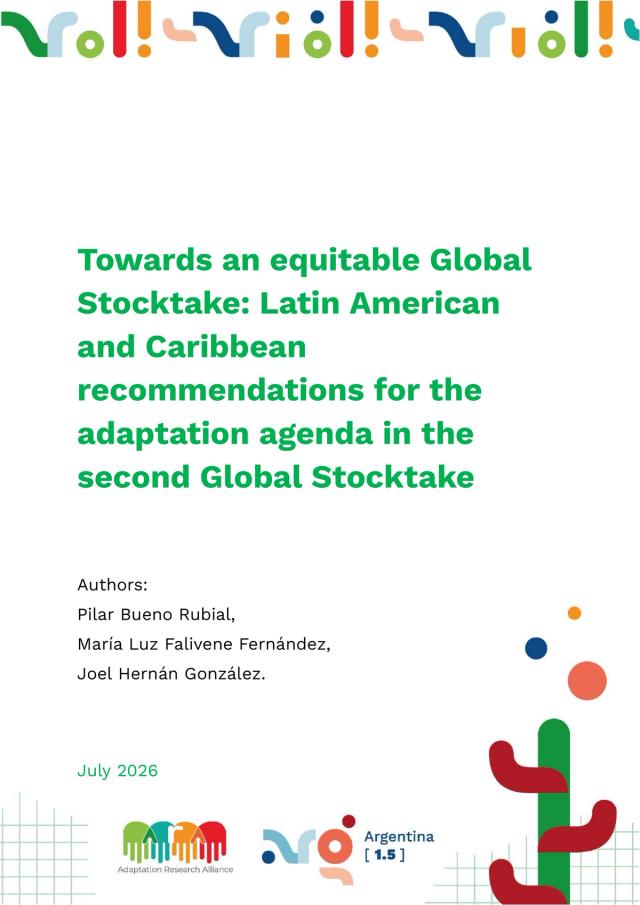
The project "Strengthening the Perspectives of Latin America and the Caribbean in the Assessment of Progress on Adaptation in the Second Global Stocktake", promoted by Argentina 1.5 and the Adaptation Research Alliance (ARA), aimed to deepen the analysis of the gaps identified in the first Global Stocktake, with special attention to the adaptation mandates of Article 7.14 of the Paris Agreement. Based on this analysis, the project sought to generate concrete regional inputs, supported by empirical evidence, to contribute to the second Global Stocktake process. Within this framework, the proposal created spaces for exchange and the substantive participation of key organizations and actors from Latin America and the Caribbean through three virtual workshops, a webinar, and a meeting with negotiators and representatives of civil society organizations during the 64th meeting of the UNFCCC subsidiary bodies. These spaces allowed for an analysis of the evolution of adaptation mandates within the Global Stocktake framework and the identification of critical gaps. This document synthesizes the evidence obtained throughout the various stages of the project, which has been used to develop recommendations and policy messages that contribute to the global process under the UNFCCC.
Towards an equitable Global Stocktake: recommendations from Latin America and the Caribbean for the adaptation agenda in the second Global Stocktake
The project "Strengthening the Perspectives of Latin America and the Caribbean in the Assessment of Progress on Adaptation in the Second Global Stocktake", promoted by Argentina 1.5 and the Adaptation Research Alliance (ARA), aimed to deepen the analysis of the gaps identified in the first Global Stocktake, with special attention to the adaptation mandates of Article 7.14 of the Paris Agreement. Based on this analysis, the project sought to generate concrete regional inputs, supported by empirical evidence, to contribute to the second Global Stocktake process. Within this framework, the proposal created spaces for exchange and the substantive participation of key organizations and actors from Latin America and the Caribbean through three virtual workshops, a webinar, and a meeting with negotiators and representatives of civil society organizations during the 64th meeting of the UNFCCC subsidiary bodies. These spaces allowed for an analysis of the evolution of adaptation mandates within the Global Stocktake framework and the identification of critical gaps. This document synthesizes the evidence obtained throughout the various stages of the project, which has been used to develop recommendations and policy messages that contribute to the global process under the UNFCCC.