
Loading document…
Brief report on the integration of the gender perspective in climate policy instruments: Nationally Determined Contributions (NDCs) and Adaptation Communications (ACs)
This policy report aims to highlight the evolution of the mainstreaming of a gender perspective in the climate policy instruments submitted by Argentina to the United Nations Framework Convention on Climate Change (UNFCCC). Within the context of the Paris Agreement, it focuses particularly on the Nationally Determined Contributions (NDCs) and Adaptation Communications (ACs).
You may also be interested
GoGoGo to publications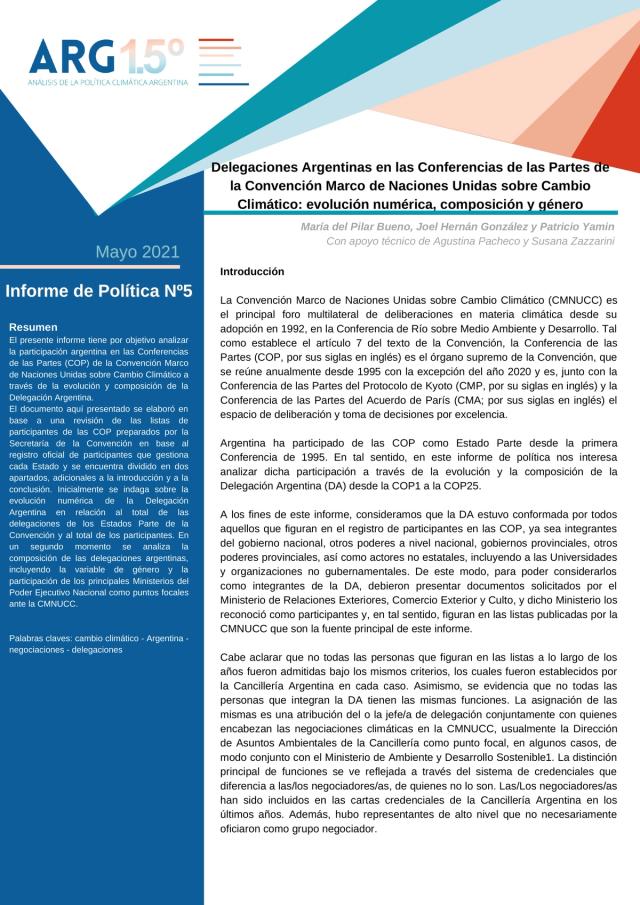
Argentine delegations at the COPs: numerical evolution, composition and gender
This report aims to analyze Argentina’s participation in the Conferences of the Parties (COPs) to the United Nations Framework Convention on Climate Change (UNFCCC) by examining the evolution and composition of the Argentine delegation. The report is based on a review of the COP participant lists prepared by the Convention Secretariat using the official participant registrations managed by each State. In addition to the introduction and conclusion, the document is divided into two sections. The first examines changes in the size of the Argentine delegation in relation to the total number of delegations representing States Parties to the Convention and the overall number of participants. The second analyzes the composition of Argentine delegations, including gender as a variable and the participation of key ministries within the National Executive Branch acting as focal points to the UNFCCC.
Argentine delegations at the COPs: numerical evolution, composition and gender
This report aims to analyze Argentina’s participation in the Conferences of the Parties (COPs) to the United Nations Framework Convention on Climate Change (UNFCCC) by examining the evolution and composition of the Argentine delegation. The report is based on a review of the COP participant lists prepared by the Convention Secretariat using the official participant registrations managed by each State. In addition to the introduction and conclusion, the document is divided into two sections. The first examines changes in the size of the Argentine delegation in relation to the total number of delegations representing States Parties to the Convention and the overall number of participants. The second analyzes the composition of Argentine delegations, including gender as a variable and the participation of key ministries within the National Executive Branch acting as focal points to the UNFCCC.
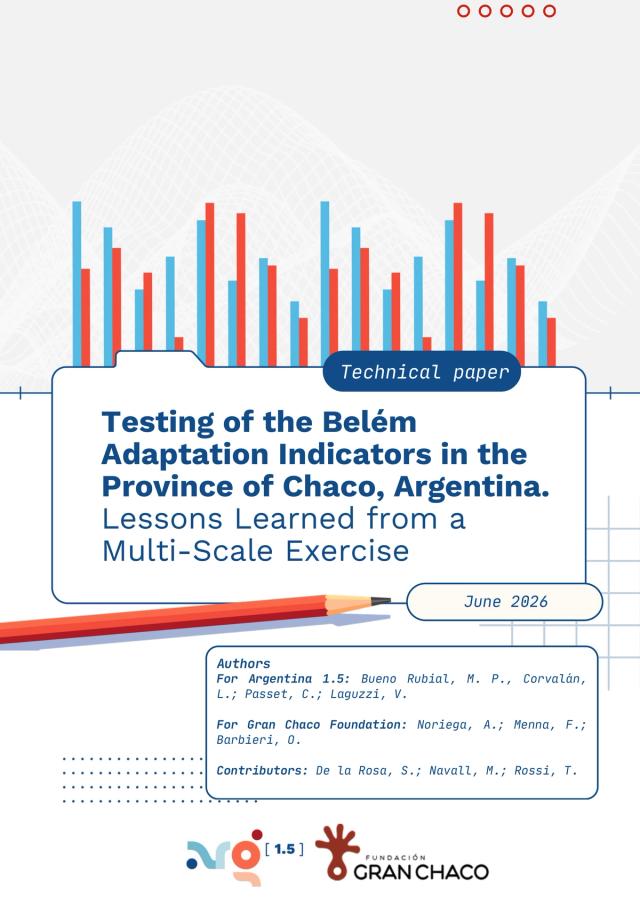
Testing of the Belém Adaptation Indicators in the Province of Chaco, Argentina. Lessons learned from a multi-scale exercise.
Argentina 1.5 and Gran Chaco Foundations have embarked on a joint journey to contribute to the testing of the BAI from a multi-scalar and multi-level perspective of adaptation. This policy report summarizes the progress made in recent months, which has involved joint capacity building and an effort to understand the extent to which BAI are applicable to the realities of the Chaco province in Argentina, and in particular, to the livestock production chain. To this end, the UAE-FGCR, along with the National Adaptation Plan (NAP) submitted by Argentina to the UNFCCC and the draft Response Plan of the Chaco province under Law 27.520, have been considered as key inputs for the exercise.
Testing of the Belém Adaptation Indicators in the Province of Chaco, Argentina. Lessons learned from a multi-scale exercise.
Argentina 1.5 and Gran Chaco Foundations have embarked on a joint journey to contribute to the testing of the BAI from a multi-scalar and multi-level perspective of adaptation. This policy report summarizes the progress made in recent months, which has involved joint capacity building and an effort to understand the extent to which BAI are applicable to the realities of the Chaco province in Argentina, and in particular, to the livestock production chain. To this end, the UAE-FGCR, along with the National Adaptation Plan (NAP) submitted by Argentina to the UNFCCC and the draft Response Plan of the Chaco province under Law 27.520, have been considered as key inputs for the exercise.
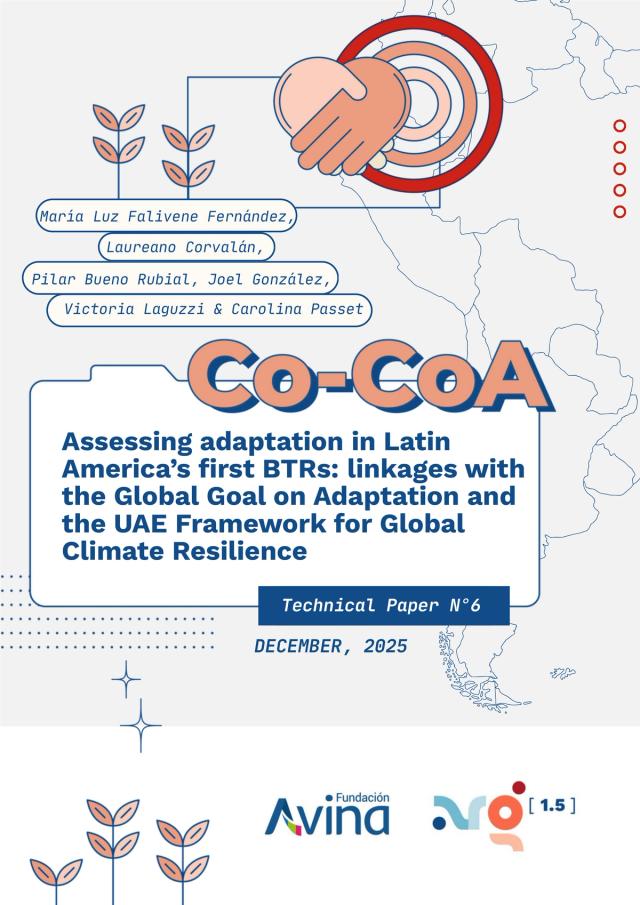
Assessing adaptation in Latin America’s first BTRs: linkages with the GGA and UAE Framework
This technical paper analyses how 19 Latin American and Caribbean countries report adaptation in their 2024–2025 Biennial Transparency Reports, assessing their contribution to operationalising the Global Goal on Adaptation and the UAE Framework for Global Climate Resilience. The findings aim to inform the second Global Stocktake under the Paris Agreement starting in 2026.
Assessing adaptation in Latin America’s first BTRs: linkages with the GGA and UAE Framework
This technical paper analyses how 19 Latin American and Caribbean countries report adaptation in their 2024–2025 Biennial Transparency Reports, assessing their contribution to operationalising the Global Goal on Adaptation and the UAE Framework for Global Climate Resilience. The findings aim to inform the second Global Stocktake under the Paris Agreement starting in 2026.