
Loading document…
Just Energy Transition and Gender: Points of Convergence at COP30
Over the past decade, the integration of a gender perspective into climate governance has undergone significant evolution within the United Nations Framework Convention on Climate Change (UNFCCC). COP30, under the presidency of Brazil, culminated in the Belém Package, which contains 29 decisions adopted by consensus on topics such as just transition, finance for adaptation, trade, technology, and gender (COP30, 2025). Related to this, one of the main achievements of COP30 was the adoption of the new Belém Gender Action Plan (2026–2034), which incorporates a broader and more robust approach than previous plans. The objective of this policy brief is to synthesize the key elements of the new Belém Gender Action Plan, highlight its links with the just transition mechanism, analyze its implications for a just energy transition, and offer strategic recommendations for Latin America and the Caribbean. The document seeks to serve as a practical tool for organizations, governments and regional actors that promote a just transition, with a focus on the energy sector and centered on the rights and effective participation of women, people of sexual diversity and local indigenous and Afro-descendant communities.
You may also be interested
GoGoGo to publications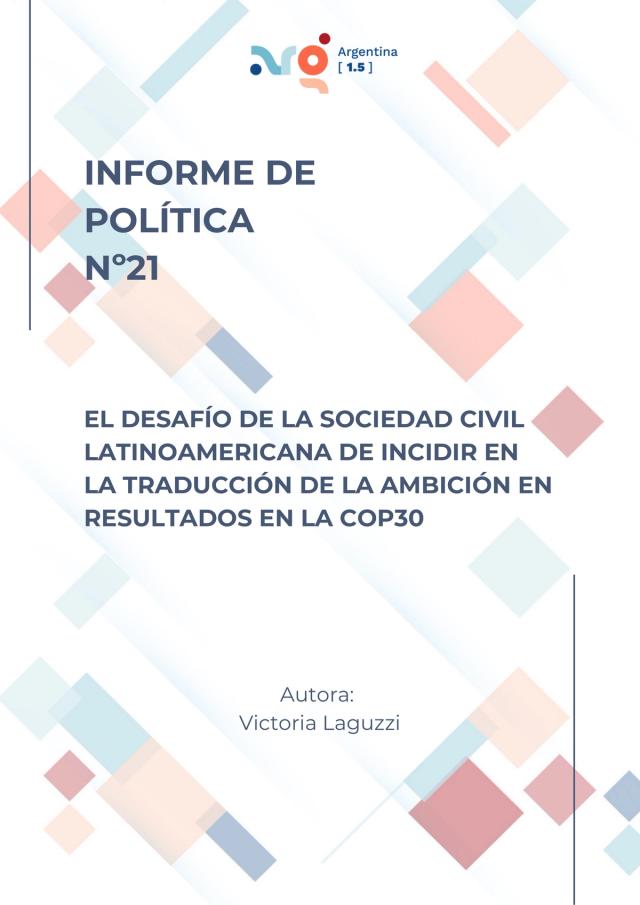
The challenge for Latin American civil society to influence the translation of ambition into results at COP30.
The final outcome of COP30 reveals a deep structural tension: while Brazil's status as host country enabled an unprecedented opening of civil society space and territorial mobilization, the formal negotiation process experienced a worrying diplomatic setback, particularly regarding the consensus reached at COP28 in Dubai on abandoning fossil fuels. In this scenario of fragmentation and power asymmetry, Latin American civil society did not act as a monolithic bloc, but rather as an inhabited ecosystem (DeJordy et al., 2020) of influence, heterogeneous and interdependent. The diversity of tactics did not express fragmentation, but rather a functional convergence aimed at sustaining climate ambition within a regime structured by minimal consensus. Through the lens of participant observation, this report analyzes how the diversity of tactics employed by Latin American civil society constituted a strategic response to the ineffectiveness of the multilateral process. The document explores how the various actors in the ecosystem formed by civil society organizations deployed persuasion techniques to sustain climate ambition, facing structural inequalities and the limits of the negotiation process in a context of high geopolitical complexity, as well as its implications for the next negotiation instances.
The challenge for Latin American civil society to influence the translation of ambition into results at COP30.
The final outcome of COP30 reveals a deep structural tension: while Brazil's status as host country enabled an unprecedented opening of civil society space and territorial mobilization, the formal negotiation process experienced a worrying diplomatic setback, particularly regarding the consensus reached at COP28 in Dubai on abandoning fossil fuels. In this scenario of fragmentation and power asymmetry, Latin American civil society did not act as a monolithic bloc, but rather as an inhabited ecosystem (DeJordy et al., 2020) of influence, heterogeneous and interdependent. The diversity of tactics did not express fragmentation, but rather a functional convergence aimed at sustaining climate ambition within a regime structured by minimal consensus. Through the lens of participant observation, this report analyzes how the diversity of tactics employed by Latin American civil society constituted a strategic response to the ineffectiveness of the multilateral process. The document explores how the various actors in the ecosystem formed by civil society organizations deployed persuasion techniques to sustain climate ambition, facing structural inequalities and the limits of the negotiation process in a context of high geopolitical complexity, as well as its implications for the next negotiation instances.
Roadmap from Latin America and the Caribbean for a just energy transition
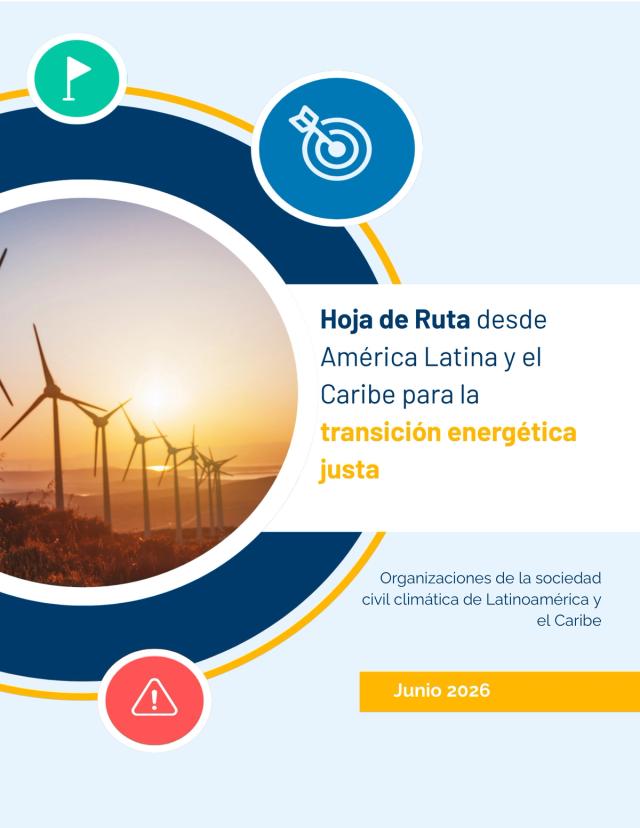
The Roadmap for a Just Energy Transition in Latin America and the Caribbean seeks to contribute to the international dialogue on a Just Energy Transition and a progressive and orderly phase-out of fossil fuels, which the region has led over the last three years through the actions of states and governments at COP 16 on Biodiversity in Cali (2024), COP 30 on Climate Change in Belém (2025), and the First Conference Beyond Fossil Fuels in Santa Marta (2026). However, this conversation has also been driven by diverse sectors of civil society, including Indigenous peoples, think tanks, social organizations, non-governmental organizations, labor unions, academia, environmental organizations, peasant organizations, and others. Today, we are moving forward with this proposed Roadmap, which includes a focus on concrete and achievable actions to reach the 1.5°C target of the Paris Agreement, but also to advance towards less unequal, more just, and more diverse societies. The document reflects the outcome of a process led by civil society organizations, regional networks, and experts from Latin America. It combines technical analysis, structured input developed through discussion and collaboration, and participatory spaces aimed at identifying practical options, sequencing strategies, barriers, and enabling conditions for advancing a gradual and orderly phase-out of fossil fuels in the region. In this way, it is hoped to contribute to the objective of identifying barriers, enabling factors, and differentiated options that can be adopted by countries, subnational entities, and economic sectors according to their specific circumstances.
Roadmap from Latin America and the Caribbean for a just energy transition
The Roadmap for a Just Energy Transition in Latin America and the Caribbean seeks to contribute to the international dialogue on a Just Energy Transition and a progressive and orderly phase-out of fossil fuels, which the region has led over the last three years through the actions of states and governments at COP 16 on Biodiversity in Cali (2024), COP 30 on Climate Change in Belém (2025), and the First Conference Beyond Fossil Fuels in Santa Marta (2026). However, this conversation has also been driven by diverse sectors of civil society, including Indigenous peoples, think tanks, social organizations, non-governmental organizations, labor unions, academia, environmental organizations, peasant organizations, and others. Today, we are moving forward with this proposed Roadmap, which includes a focus on concrete and achievable actions to reach the 1.5°C target of the Paris Agreement, but also to advance towards less unequal, more just, and more diverse societies. The document reflects the outcome of a process led by civil society organizations, regional networks, and experts from Latin America. It combines technical analysis, structured input developed through discussion and collaboration, and participatory spaces aimed at identifying practical options, sequencing strategies, barriers, and enabling conditions for advancing a gradual and orderly phase-out of fossil fuels in the region. In this way, it is hoped to contribute to the objective of identifying barriers, enabling factors, and differentiated options that can be adopted by countries, subnational entities, and economic sectors according to their specific circumstances.
Progress in the synergy between climate action and SDGs in Latin America and Argentina
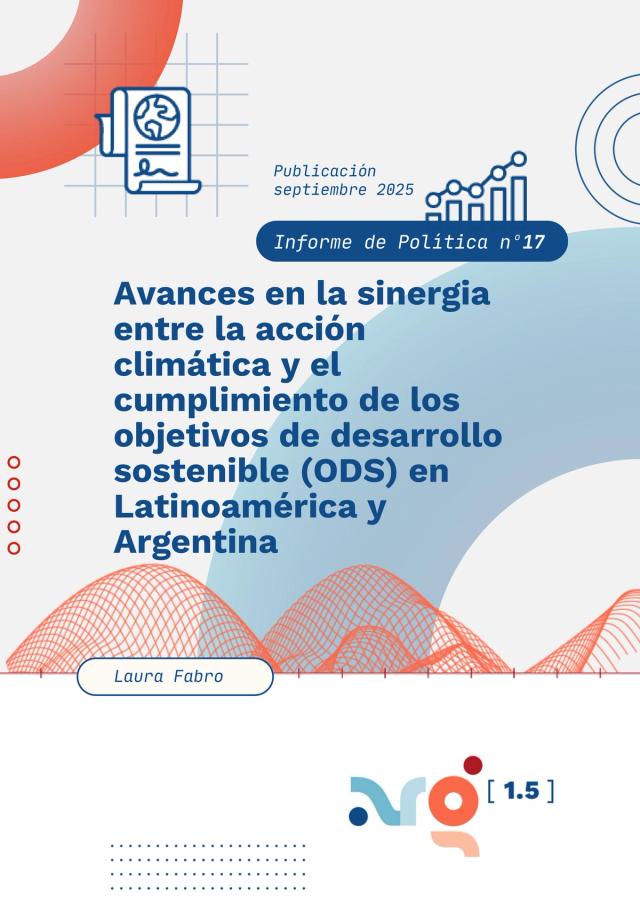
The objective of this policy report is to analyze the progress of the synergy between achieving the Sustainable Development Goals (SDGs) and climate action, as seen through the six global conferences on the topic. The most recent conference (in Copenhagen, 2025) again concluded that it is necessary to break down silos and strengthen synergies between climate action, environmental protection, and the SDGs to accelerate the necessary and urgent transitions toward a just, inclusive, and decarbonized future. Global progress and challenges for Latin America and Argentina are assessed. Furthermore, the report analyzes perspectives that can promote climate action and the achievement of the SDGs.
Progress in the synergy between climate action and SDGs in Latin America and Argentina
The objective of this policy report is to analyze the progress of the synergy between achieving the Sustainable Development Goals (SDGs) and climate action, as seen through the six global conferences on the topic. The most recent conference (in Copenhagen, 2025) again concluded that it is necessary to break down silos and strengthen synergies between climate action, environmental protection, and the SDGs to accelerate the necessary and urgent transitions toward a just, inclusive, and decarbonized future. Global progress and challenges for Latin America and Argentina are assessed. Furthermore, the report analyzes perspectives that can promote climate action and the achievement of the SDGs.