
Loading document…
Regulatory and institutional regressions in environmental and climate governance in Argentina
Since December 2023, Argentina has been undergoing a period of debate and transformation in its environmental and climate policy, characterized by institutional reforms and a weakening of protection standards, which puts it at odds with the principle of non-regression. Among the main changes are the reduction of the institutional scope of the national environmental and climate sector, budget cuts, proposals to relax regulations related to the management and exploitation of natural resources and extractive activities, and changes to the system of minimum environmental standards. One of the most relevant debates is the reform of legislation protecting glaciers and the periglacial environment, which has been heavily criticized for the substantial modifications it introduces, primarily the restriction of protected areas and the transfer of regulatory powers to the provinces, with direct impacts on national climate policy. The tensions arising from deregulation processes, increasing demands for environmental protection, and the need to uphold international commitments made in the face of the climate crisis highlight the need to strengthen institutional capacities, guarantee minimum environmental protection standards, and consolidate effective governance mechanisms.
You may also be interested
GoGoGo to publications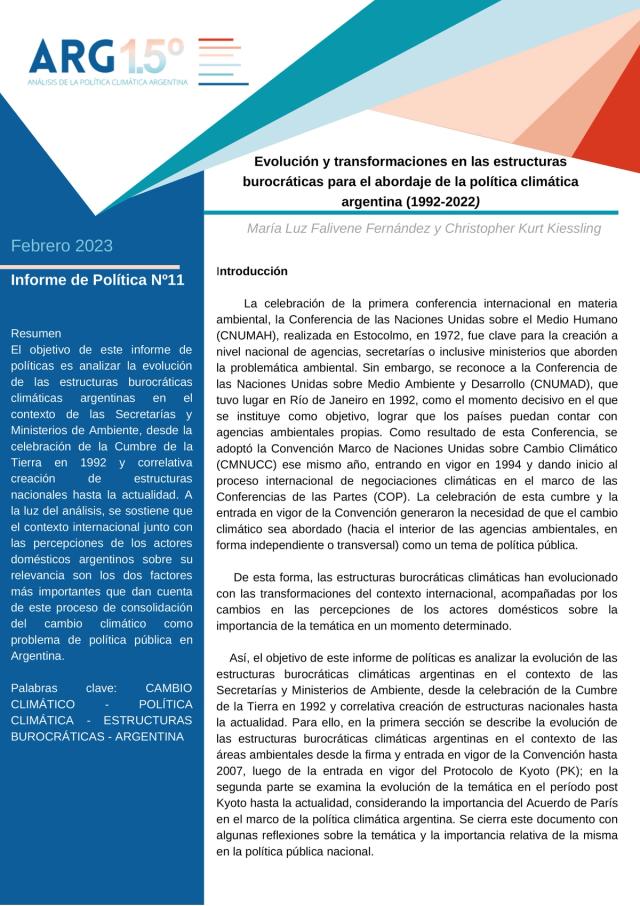
Evolution and transformations in climate bureaucratic structures (1992-2022)
The objective of this policy report is to analyze the evolution of Argentina's climate bureaucratic structures within the framework of the Ministries and Secretariats of the Environment, from the 1992 Earth Summit and the subsequent creation of national structures to the present day. The analysis argues that the international context, along with the perceptions of Argentine domestic actors regarding its relevance, are the two most important factors explaining the consolidation of climate change as a public policy issue in Argentina.
Evolution and transformations in climate bureaucratic structures (1992-2022)
The objective of this policy report is to analyze the evolution of Argentina's climate bureaucratic structures within the framework of the Ministries and Secretariats of the Environment, from the 1992 Earth Summit and the subsequent creation of national structures to the present day. The analysis argues that the international context, along with the perceptions of Argentine domestic actors regarding its relevance, are the two most important factors explaining the consolidation of climate change as a public policy issue in Argentina.
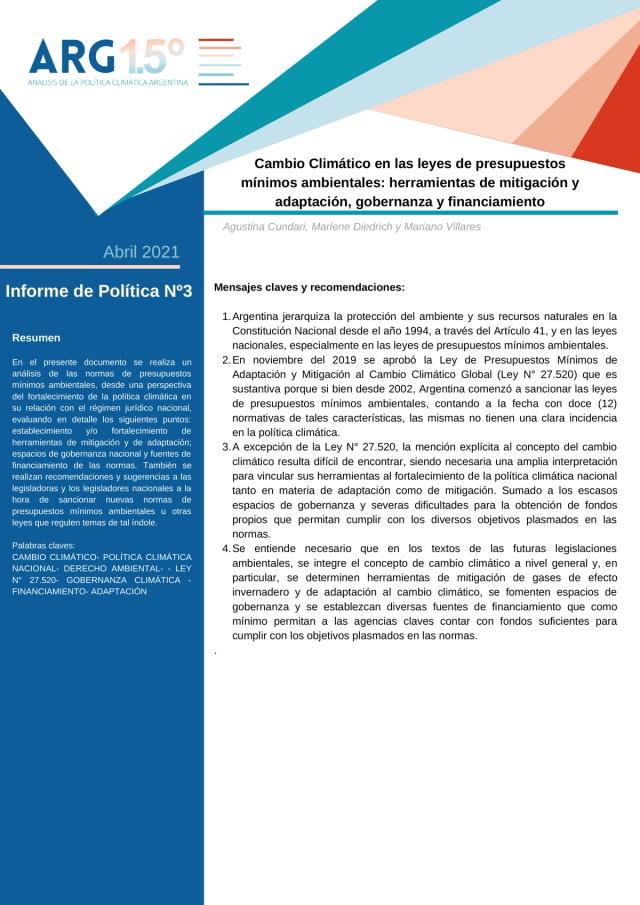
Minimum budget laws: mitigation, adaptation, governance and financing
This document analyzes Argentina’s environmental minimum standards legislation from the perspective of strengthening climate policy and its relationship with the national legal framework. It provides a detailed assessment of the following aspects: the establishment and/or strengthening of mitigation and adaptation tools; national governance arrangements; and funding sources for the implementation of such legislation. The document also offers recommendations and suggestions for national legislators to consider when enacting new environmental minimum standards legislation or other laws addressing related issues.
Minimum budget laws: mitigation, adaptation, governance and financing
This document analyzes Argentina’s environmental minimum standards legislation from the perspective of strengthening climate policy and its relationship with the national legal framework. It provides a detailed assessment of the following aspects: the establishment and/or strengthening of mitigation and adaptation tools; national governance arrangements; and funding sources for the implementation of such legislation. The document also offers recommendations and suggestions for national legislators to consider when enacting new environmental minimum standards legislation or other laws addressing related issues.
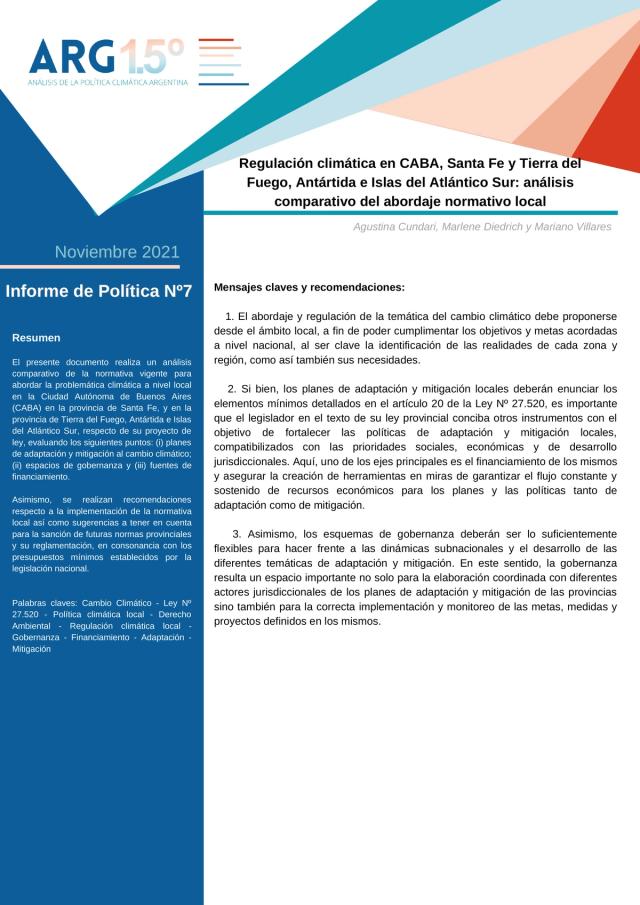
Climate regulation in CABA, Santa Fe and Tierra del Fuego: a comparative analysis
This document presents a comparative analysis of current regulations addressing climate change issues at the local level in the Autonomous City of Buenos Aires (CABA), the province of Santa Fe, and the province of Tierra del Fuego, Antarctica and the South Atlantic Islands, in relation to their respective draft laws. The analysis evaluates the following points: (i) climate change adaptation and mitigation plans; (ii) governance structures; and (iii) funding sources. Furthermore, it offers recommendations regarding the implementation of local regulations, as well as suggestions for the enactment and regulation of future provincial laws, in accordance with the minimum standards established by national legislation.
Climate regulation in CABA, Santa Fe and Tierra del Fuego: a comparative analysis
This document presents a comparative analysis of current regulations addressing climate change issues at the local level in the Autonomous City of Buenos Aires (CABA), the province of Santa Fe, and the province of Tierra del Fuego, Antarctica and the South Atlantic Islands, in relation to their respective draft laws. The analysis evaluates the following points: (i) climate change adaptation and mitigation plans; (ii) governance structures; and (iii) funding sources. Furthermore, it offers recommendations regarding the implementation of local regulations, as well as suggestions for the enactment and regulation of future provincial laws, in accordance with the minimum standards established by national legislation.