
Loading document…
Deforestation Roadmap: discussions and structuring elements on the road to COP31 in Antalya
Forests provide essential ecosystem services for addressing the global environmental and climate crisis. Their capacity to store carbon, regulate hydrological cycles, stabilize regional temperatures, conserve biodiversity, and sustain the livelihoods of millions of people makes them a central component of international mitigation and adaptation strategies. Given their importance, forest management has gained increasing prominence on the international agenda. The most recent effort to revitalize this agenda is the Roadmap to Halt and Reverse Deforestation and Forest Degradation by 2030, launched by the COP30 Presidency in response to paragraphs 33 and 34 of the first Global Stocktake. This Policy Brief aims to briefly reconstruct the evolution of the forest agenda within the UNFCCC; examine the key features of the initiative; and highlight the main elements that emerged from the submissions and discussions held by the Parties. Finally, it is proposed to identify a series of barriers and recommendations associated with them, aimed at strengthening the Leaflet process on the way to the Conference of the Parties (COP31) of the UNFCCC that will take place in Antalya.
You may also be interested
GoGoGo to publications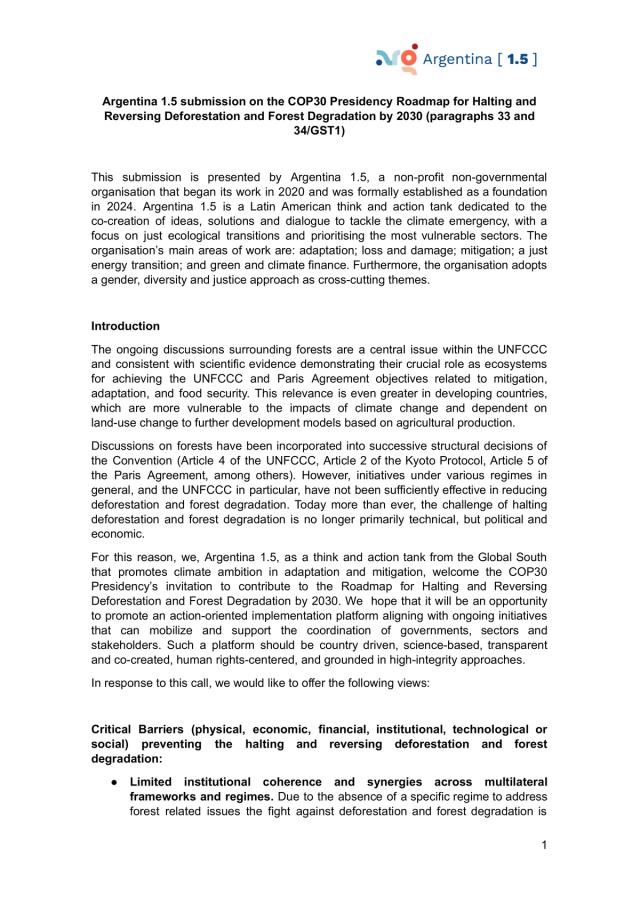
Argentina 1.5 submission on the COP30 Presidency Roadmap for Halting and Reversing Deforestation and Forest Degradation by 2030
Argentina 1.5, as a think and action tank from the Global South that promotes climate ambition in adaptation and mitigation, welcomes the COP30 Presidency’s invitation to contribute to the Roadmap for Halting and Reversing Deforestation and Forest Degradation by 2030. We hope that it will be an opportunity to promote an action-oriented implementation platform aligning with ongoing initiatives that can mobilize and support the coordination of governments, sectors, and stakeholders. Such a platform should be country-driven, science-based, transparent and co-created, human rights-centered, and grounded in high-integrity approaches.
Argentina 1.5 submission on the COP30 Presidency Roadmap for Halting and Reversing Deforestation and Forest Degradation by 2030
Argentina 1.5, as a think and action tank from the Global South that promotes climate ambition in adaptation and mitigation, welcomes the COP30 Presidency’s invitation to contribute to the Roadmap for Halting and Reversing Deforestation and Forest Degradation by 2030. We hope that it will be an opportunity to promote an action-oriented implementation platform aligning with ongoing initiatives that can mobilize and support the coordination of governments, sectors, and stakeholders. Such a platform should be country-driven, science-based, transparent and co-created, human rights-centered, and grounded in high-integrity approaches.
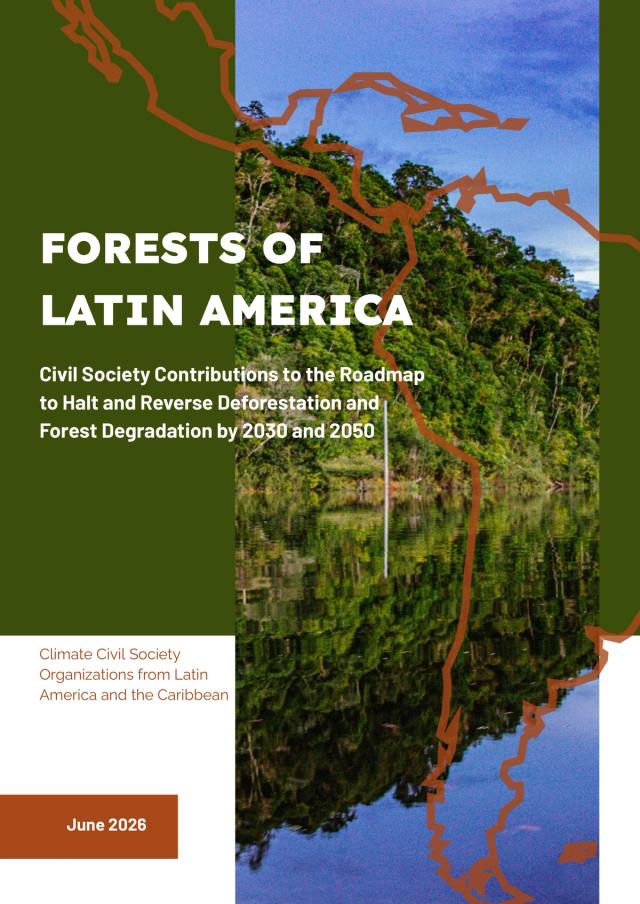
Submission by 44 civil society organizations from Latin America as a contribution to the Roadmap to Halt and Reverse Deforestation and Forest Degradation by 2030 and 2050
This contribution from Latin American civil society organizations aims to inform the global Roadmap to Halt and Reverse Forest Deforestation and Degradation by 2030, from an implementation perspective and with a regional identity. It proposes priorities and actionable targets, anchored in Latin America's own challenges, that countries can adopt, backed by regional, bilateral, and multilateral partnerships, and integrated into existing instruments to accelerate results before 2030.
Submission by 44 civil society organizations from Latin America as a contribution to the Roadmap to Halt and Reverse Deforestation and Forest Degradation by 2030 and 2050
This contribution from Latin American civil society organizations aims to inform the global Roadmap to Halt and Reverse Forest Deforestation and Degradation by 2030, from an implementation perspective and with a regional identity. It proposes priorities and actionable targets, anchored in Latin America's own challenges, that countries can adopt, backed by regional, bilateral, and multilateral partnerships, and integrated into existing instruments to accelerate results before 2030.
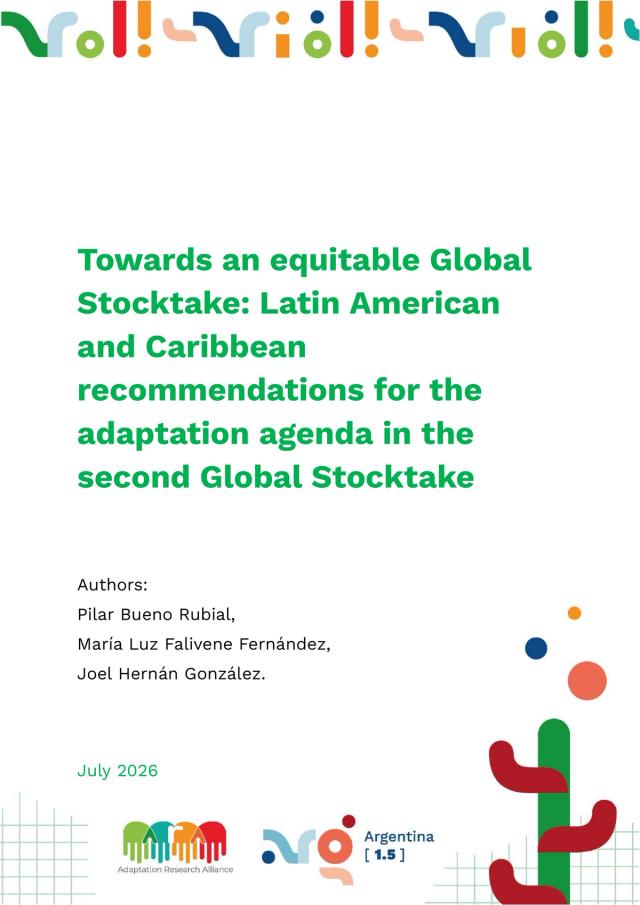
Towards an equitable Global Stocktake: recommendations from Latin America and the Caribbean for the adaptation agenda in the second Global Stocktake
The project "Strengthening the Perspectives of Latin America and the Caribbean in the Assessment of Progress on Adaptation in the Second Global Stocktake", promoted by Argentina 1.5 and the Adaptation Research Alliance (ARA), aimed to deepen the analysis of the gaps identified in the first Global Stocktake, with special attention to the adaptation mandates of Article 7.14 of the Paris Agreement. Based on this analysis, the project sought to generate concrete regional inputs, supported by empirical evidence, to contribute to the second Global Stocktake process. Within this framework, the proposal created spaces for exchange and the substantive participation of key organizations and actors from Latin America and the Caribbean through three virtual workshops, a webinar, and a meeting with negotiators and representatives of civil society organizations during the 64th meeting of the UNFCCC subsidiary bodies. These spaces allowed for an analysis of the evolution of adaptation mandates within the Global Stocktake framework and the identification of critical gaps. This document synthesizes the evidence obtained throughout the various stages of the project, which has been used to develop recommendations and policy messages that contribute to the global process under the UNFCCC.
Towards an equitable Global Stocktake: recommendations from Latin America and the Caribbean for the adaptation agenda in the second Global Stocktake
The project "Strengthening the Perspectives of Latin America and the Caribbean in the Assessment of Progress on Adaptation in the Second Global Stocktake", promoted by Argentina 1.5 and the Adaptation Research Alliance (ARA), aimed to deepen the analysis of the gaps identified in the first Global Stocktake, with special attention to the adaptation mandates of Article 7.14 of the Paris Agreement. Based on this analysis, the project sought to generate concrete regional inputs, supported by empirical evidence, to contribute to the second Global Stocktake process. Within this framework, the proposal created spaces for exchange and the substantive participation of key organizations and actors from Latin America and the Caribbean through three virtual workshops, a webinar, and a meeting with negotiators and representatives of civil society organizations during the 64th meeting of the UNFCCC subsidiary bodies. These spaces allowed for an analysis of the evolution of adaptation mandates within the Global Stocktake framework and the identification of critical gaps. This document synthesizes the evidence obtained throughout the various stages of the project, which has been used to develop recommendations and policy messages that contribute to the global process under the UNFCCC.