

Research
to turn
evidence into action
Explore reports, technical documents and publications that aim to strengthen climate policies at the subnational, national and international levels, promoting the development of the most vulnerable communities.
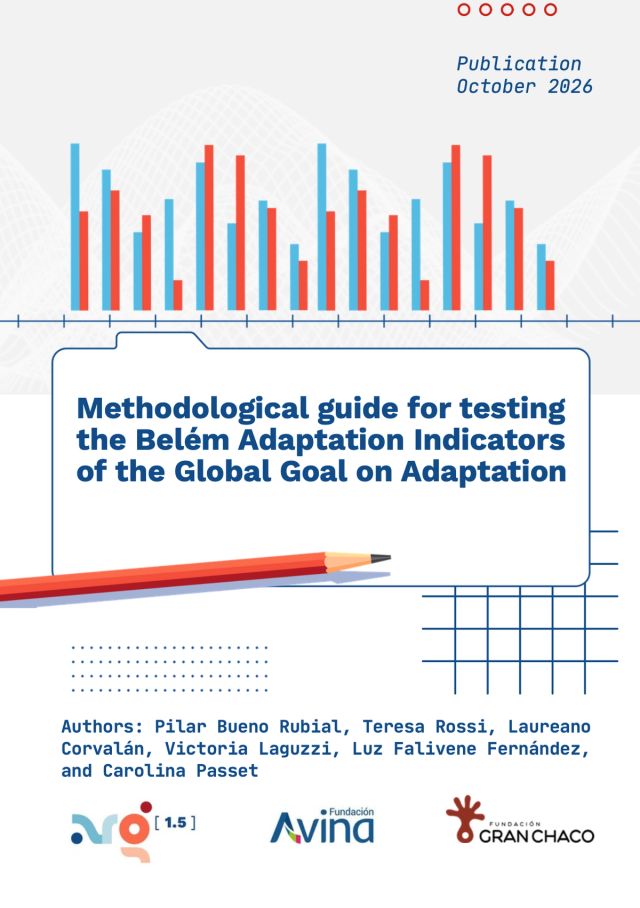
Methodological guide for testing the Belém Adaptation Indicators of the Global Goal on Adaptation
This guide was developed by Fundación Argentina 1.5 and Fundación Gran Chaco, with the support of Fundación Avina, combining the organizations' experiences with multi-level adaptation actions and drawing upon a pilot exercise conducted in the province of Chaco, Argentina. The guide aims to contribute to the global effort to pilot the Belém Adaptation Indicators by offering a practical perspective based on 11 interviews with representatives from countries, country groups, and organizations that generously shared their processes, challenges, and expectations.
Methodological guide for testing the Belém Adaptation Indicators of the Global Goal on Adaptation
This guide was developed by Fundación Argentina 1.5 and Fundación Gran Chaco, with the support of Fundación Avina, combining the organizations' experiences with multi-level adaptation actions and drawing upon a pilot exercise conducted in the province of Chaco, Argentina. The guide aims to contribute to the global effort to pilot the Belém Adaptation Indicators by offering a practical perspective based on 11 interviews with representatives from countries, country groups, and organizations that generously shared their processes, challenges, and expectations.
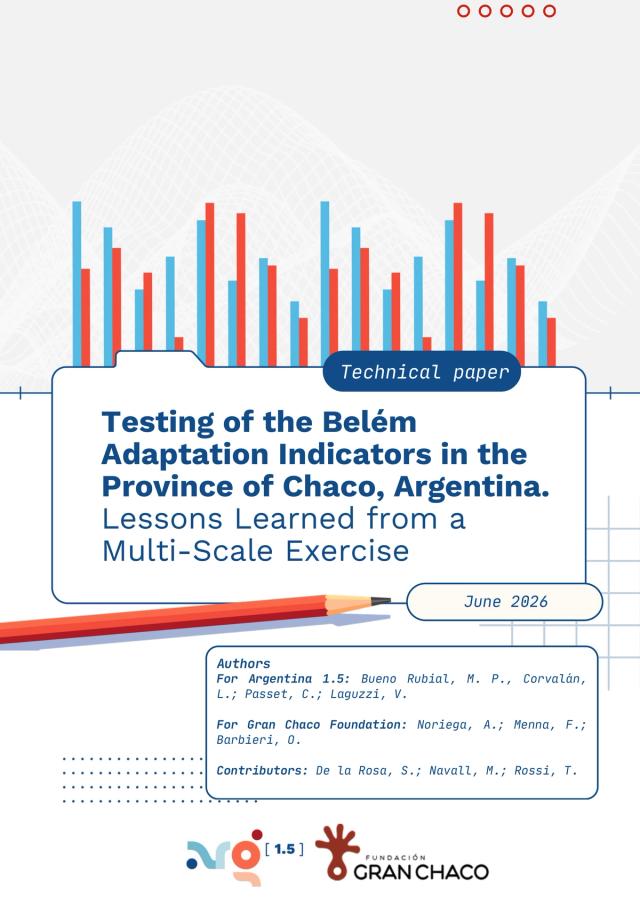
Testing of the Belém Adaptation Indicators in the Province of Chaco, Argentina. Lessons learned from a multi-scale exercise.
Argentina 1.5 and Gran Chaco Foundations have embarked on a joint journey to contribute to the testing of the BAI from a multi-scalar and multi-level perspective of adaptation. This policy report summarizes the progress made in recent months, which has involved joint capacity building and an effort to understand the extent to which BAI are applicable to the realities of the Chaco province in Argentina, and in particular, to the livestock production chain. To this end, the UAE-FGCR, along with the National Adaptation Plan (NAP) submitted by Argentina to the UNFCCC and the draft Response Plan of the Chaco province under Law 27.520, have been considered as key inputs for the exercise.
Testing of the Belém Adaptation Indicators in the Province of Chaco, Argentina. Lessons learned from a multi-scale exercise.
Argentina 1.5 and Gran Chaco Foundations have embarked on a joint journey to contribute to the testing of the BAI from a multi-scalar and multi-level perspective of adaptation. This policy report summarizes the progress made in recent months, which has involved joint capacity building and an effort to understand the extent to which BAI are applicable to the realities of the Chaco province in Argentina, and in particular, to the livestock production chain. To this end, the UAE-FGCR, along with the National Adaptation Plan (NAP) submitted by Argentina to the UNFCCC and the draft Response Plan of the Chaco province under Law 27.520, have been considered as key inputs for the exercise.
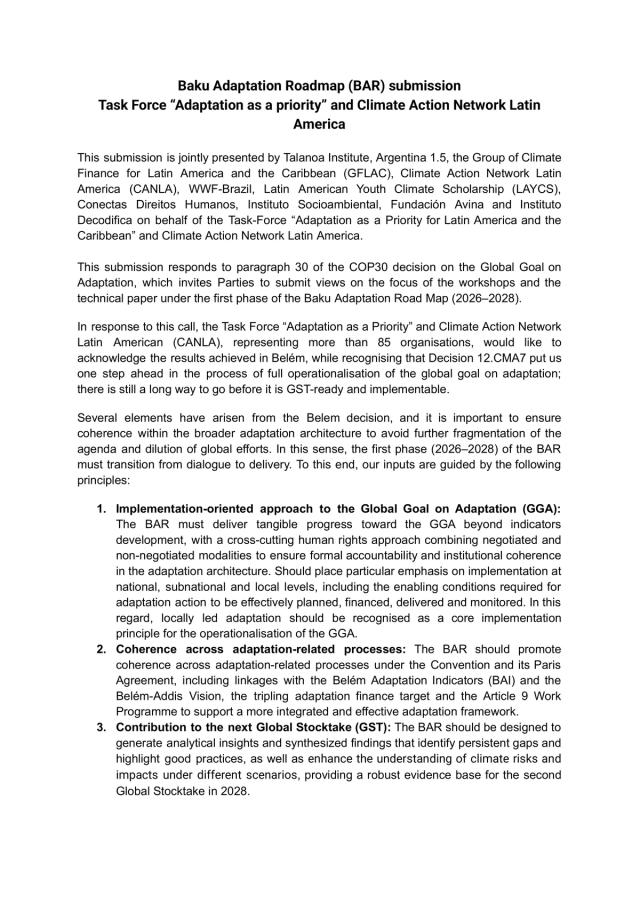
Submission by Task Force «Adaptation as a priority» and CANLA on the Baku Adaptation Roadmap
This submission is jointly presented by Talanoa Institute, Argentina 1.5, the Group of Climate Finance for Latin America and the Caribbean (GFLAC), Climate Action Network Latin America (CANLA), WWF-Brazil, Latin American Youth Climate Scholarship (LAYCS), Conectas Direitos Humanos, Instituto Socioambiental, Fundación Avina, and Instituto Decodifica on behalf of the Task-Force “Adaptation as a Priority for Latin America and the Caribbean” and Climate Action Network Latin America. This submission responds to paragraph 30 of the COP30 decision on the Global Goal on Adaptation, which invites Parties to submit views on the focus of the workshops and the technical paper under the first phase of the Baku Adaptation Road Map (2026–2028).
Submission by Task Force «Adaptation as a priority» and CANLA on the Baku Adaptation Roadmap
This submission is jointly presented by Talanoa Institute, Argentina 1.5, the Group of Climate Finance for Latin America and the Caribbean (GFLAC), Climate Action Network Latin America (CANLA), WWF-Brazil, Latin American Youth Climate Scholarship (LAYCS), Conectas Direitos Humanos, Instituto Socioambiental, Fundación Avina, and Instituto Decodifica on behalf of the Task-Force “Adaptation as a Priority for Latin America and the Caribbean” and Climate Action Network Latin America. This submission responds to paragraph 30 of the COP30 decision on the Global Goal on Adaptation, which invites Parties to submit views on the focus of the workshops and the technical paper under the first phase of the Baku Adaptation Road Map (2026–2028).
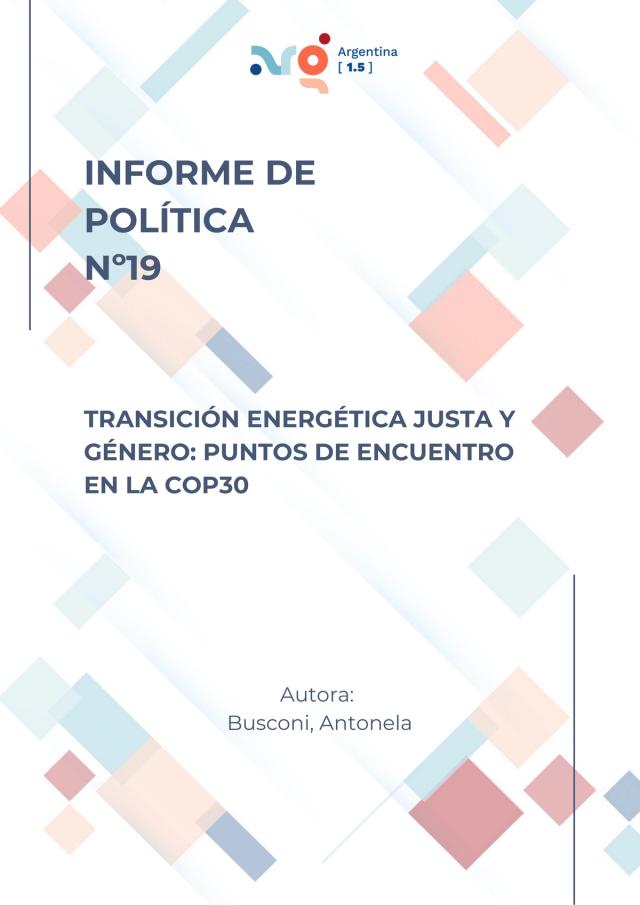
Just Energy Transition and Gender: Points of Convergence at COP30
Over the past decade, the integration of a gender perspective into climate governance has undergone significant evolution within the United Nations Framework Convention on Climate Change (UNFCCC). COP30, under the presidency of Brazil, culminated in the Belém Package, which contains 29 decisions adopted by consensus on topics such as just transition, finance for adaptation, trade, technology, and gender (COP30, 2025). Related to this, one of the main achievements of COP30 was the adoption of the new Belém Gender Action Plan (2026–2034), which incorporates a broader and more robust approach than previous plans. The objective of this policy brief is to synthesize the key elements of the new Belém Gender Action Plan, highlight its links with the just transition mechanism, analyze its implications for a just energy transition, and offer strategic recommendations for Latin America and the Caribbean. The document seeks to serve as a practical tool for organizations, governments and regional actors that promote a just transition, with a focus on the energy sector and centered on the rights and effective participation of women, people of sexual diversity and local indigenous and Afro-descendant communities.
Just Energy Transition and Gender: Points of Convergence at COP30
Over the past decade, the integration of a gender perspective into climate governance has undergone significant evolution within the United Nations Framework Convention on Climate Change (UNFCCC). COP30, under the presidency of Brazil, culminated in the Belém Package, which contains 29 decisions adopted by consensus on topics such as just transition, finance for adaptation, trade, technology, and gender (COP30, 2025). Related to this, one of the main achievements of COP30 was the adoption of the new Belém Gender Action Plan (2026–2034), which incorporates a broader and more robust approach than previous plans. The objective of this policy brief is to synthesize the key elements of the new Belém Gender Action Plan, highlight its links with the just transition mechanism, analyze its implications for a just energy transition, and offer strategic recommendations for Latin America and the Caribbean. The document seeks to serve as a practical tool for organizations, governments and regional actors that promote a just transition, with a focus on the energy sector and centered on the rights and effective participation of women, people of sexual diversity and local indigenous and Afro-descendant communities.
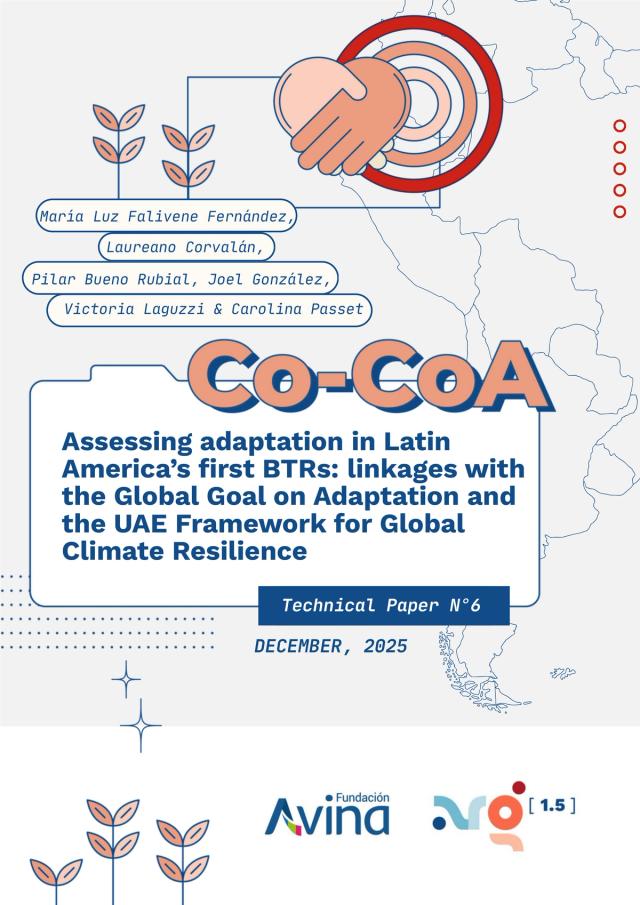
Assessing adaptation in Latin America’s first BTRs: linkages with the GGA and UAE Framework
This technical paper analyses how 19 Latin American and Caribbean countries report adaptation in their 2024–2025 Biennial Transparency Reports, assessing their contribution to operationalising the Global Goal on Adaptation and the UAE Framework for Global Climate Resilience. The findings aim to inform the second Global Stocktake under the Paris Agreement starting in 2026.
Assessing adaptation in Latin America’s first BTRs: linkages with the GGA and UAE Framework
This technical paper analyses how 19 Latin American and Caribbean countries report adaptation in their 2024–2025 Biennial Transparency Reports, assessing their contribution to operationalising the Global Goal on Adaptation and the UAE Framework for Global Climate Resilience. The findings aim to inform the second Global Stocktake under the Paris Agreement starting in 2026.
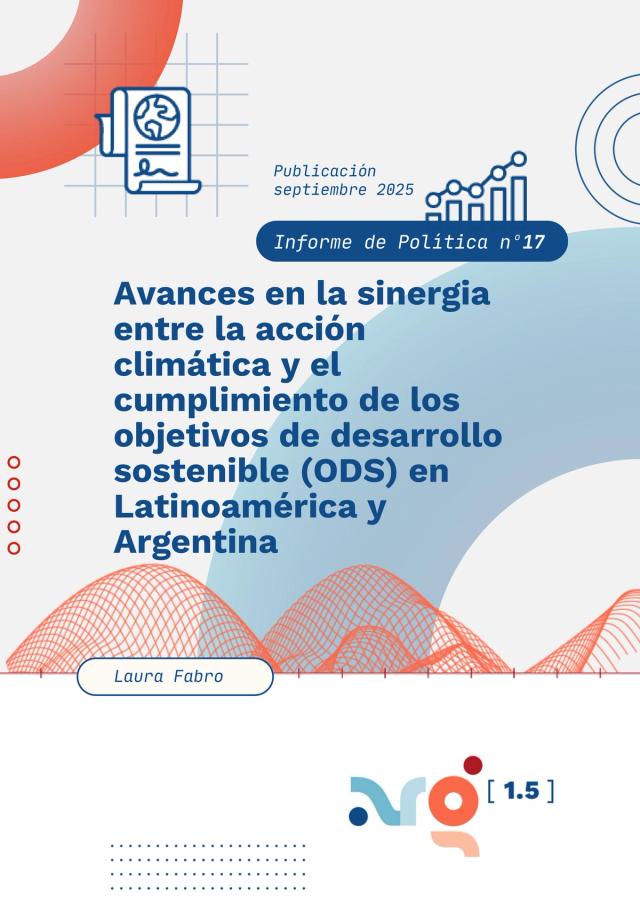
Progress in the synergy between climate action and SDGs in Latin America and Argentina
The objective of this policy report is to analyze the progress of the synergy between achieving the Sustainable Development Goals (SDGs) and climate action, as seen through the six global conferences on the topic. The most recent conference (in Copenhagen, 2025) again concluded that it is necessary to break down silos and strengthen synergies between climate action, environmental protection, and the SDGs to accelerate the necessary and urgent transitions toward a just, inclusive, and decarbonized future. Global progress and challenges for Latin America and Argentina are assessed. Furthermore, the report analyzes perspectives that can promote climate action and the achievement of the SDGs.
Progress in the synergy between climate action and SDGs in Latin America and Argentina
The objective of this policy report is to analyze the progress of the synergy between achieving the Sustainable Development Goals (SDGs) and climate action, as seen through the six global conferences on the topic. The most recent conference (in Copenhagen, 2025) again concluded that it is necessary to break down silos and strengthen synergies between climate action, environmental protection, and the SDGs to accelerate the necessary and urgent transitions toward a just, inclusive, and decarbonized future. Global progress and challenges for Latin America and Argentina are assessed. Furthermore, the report analyzes perspectives that can promote climate action and the achievement of the SDGs.