

Research
to turn
evidence into action
Explore reports, technical documents and publications that aim to strengthen climate policies at the subnational, national and international levels, promoting the development of the most vulnerable communities.
Methodological guide for testing the Belém Adaptation Indicators of the Global Goal on Adaptation
This guide was developed by Fundación Argentina 1.5 and Fundación Gran Chaco, with the support of Fundación Avina, combining the organizations' experiences with multi-level adaptation actions and drawing upon a pilot exercise conducted in the province of Chaco, Argentina. The guide aims to contribute to the global effort to pilot the Belém Adaptation Indicators by offering a practical perspective based on 11 interviews with representatives from countries, country groups, and organizations that generously shared their processes, challenges, and expectations.
Methodological guide for testing the Belém Adaptation Indicators of the Global Goal on Adaptation
This guide was developed by Fundación Argentina 1.5 and Fundación Gran Chaco, with the support of Fundación Avina, combining the organizations' experiences with multi-level adaptation actions and drawing upon a pilot exercise conducted in the province of Chaco, Argentina. The guide aims to contribute to the global effort to pilot the Belém Adaptation Indicators by offering a practical perspective based on 11 interviews with representatives from countries, country groups, and organizations that generously shared their processes, challenges, and expectations.
Roadmap from Latin America and the Caribbean for a just energy transition
The Roadmap for a Just Energy Transition in Latin America and the Caribbean seeks to contribute to the international dialogue on a Just Energy Transition and a progressive and orderly phase-out of fossil fuels, which the region has led over the last three years through the actions of states and governments at COP 16 on Biodiversity in Cali (2024), COP 30 on Climate Change in Belém (2025), and the First Conference Beyond Fossil Fuels in Santa Marta (2026). However, this conversation has also been driven by diverse sectors of civil society, including Indigenous peoples, think tanks, social organizations, non-governmental organizations, labor unions, academia, environmental organizations, peasant organizations, and others. Today, we are moving forward with this proposed Roadmap, which includes a focus on concrete and achievable actions to reach the 1.5°C target of the Paris Agreement, but also to advance towards less unequal, more just, and more diverse societies. The document reflects the outcome of a process led by civil society organizations, regional networks, and experts from Latin America. It combines technical analysis, structured input developed through discussion and collaboration, and participatory spaces aimed at identifying practical options, sequencing strategies, barriers, and enabling conditions for advancing a gradual and orderly phase-out of fossil fuels in the region. In this way, it is hoped to contribute to the objective of identifying barriers, enabling factors, and differentiated options that can be adopted by countries, subnational entities, and economic sectors according to their specific circumstances.
Roadmap from Latin America and the Caribbean for a just energy transition
The Roadmap for a Just Energy Transition in Latin America and the Caribbean seeks to contribute to the international dialogue on a Just Energy Transition and a progressive and orderly phase-out of fossil fuels, which the region has led over the last three years through the actions of states and governments at COP 16 on Biodiversity in Cali (2024), COP 30 on Climate Change in Belém (2025), and the First Conference Beyond Fossil Fuels in Santa Marta (2026). However, this conversation has also been driven by diverse sectors of civil society, including Indigenous peoples, think tanks, social organizations, non-governmental organizations, labor unions, academia, environmental organizations, peasant organizations, and others. Today, we are moving forward with this proposed Roadmap, which includes a focus on concrete and achievable actions to reach the 1.5°C target of the Paris Agreement, but also to advance towards less unequal, more just, and more diverse societies. The document reflects the outcome of a process led by civil society organizations, regional networks, and experts from Latin America. It combines technical analysis, structured input developed through discussion and collaboration, and participatory spaces aimed at identifying practical options, sequencing strategies, barriers, and enabling conditions for advancing a gradual and orderly phase-out of fossil fuels in the region. In this way, it is hoped to contribute to the objective of identifying barriers, enabling factors, and differentiated options that can be adopted by countries, subnational entities, and economic sectors according to their specific circumstances.
Written contributions for the First Conference on Transitioning Away from Fossil Fuels
Argentina 1.5 presents the following written contributions for the First Conference on Transitioning Away from Fossil Fuels. Given the organization's history, we focus particularly on strengthening international cooperation and climate diplomacy, while also including references to reducing economic dependence on fossil fuels.
Written contributions for the First Conference on Transitioning Away from Fossil Fuels
Argentina 1.5 presents the following written contributions for the First Conference on Transitioning Away from Fossil Fuels. Given the organization's history, we focus particularly on strengthening international cooperation and climate diplomacy, while also including references to reducing economic dependence on fossil fuels.
Statement prepared by Fundación Argentina 1.5 Grados Centígrados on the occasion of the Public Hearing for the bill under review on the modification of the minimum budget regime for the protection of glaciers and the periglacial environment (File 0072-S-2025)
Argentina faces a critical juncture in the protection of its strategic water resources. Glaciers constitute a key natural infrastructure for water security and the management of current and future climate risks, as well as being part of its cultural heritage. Weakening their protection not only represents an environmental setback, but also increases economic, social, and institutional risks in a context of greater climate variability, recurring droughts, and pressure on freshwater resources.
Statement prepared by Fundación Argentina 1.5 Grados Centígrados on the occasion of the Public Hearing for the bill under review on the modification of the minimum budget regime for the protection of glaciers and the periglacial environment (File 0072-S-2025)
Argentina faces a critical juncture in the protection of its strategic water resources. Glaciers constitute a key natural infrastructure for water security and the management of current and future climate risks, as well as being part of its cultural heritage. Weakening their protection not only represents an environmental setback, but also increases economic, social, and institutional risks in a context of greater climate variability, recurring droughts, and pressure on freshwater resources.
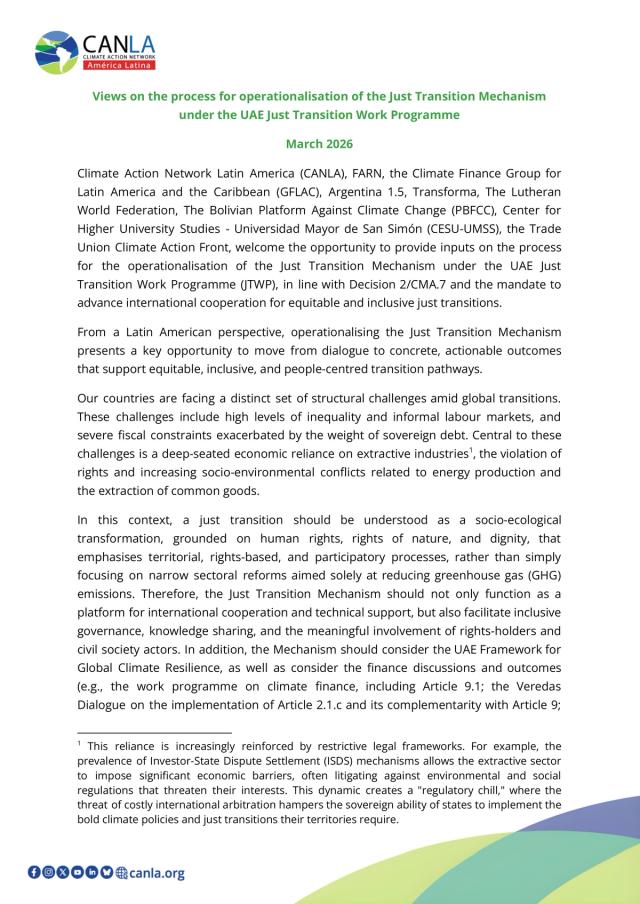
Submission by CAN and CANLA on Views on the process for the operationalisation of the Just Transition Mechanism under the UAE Just Transition Work Programme
Climate Action Network Latin America (CANLA), FARN, the Climate Finance Group for Latin America and the Caribbean (GFLAC), Argentina 1.5, Transforma, The Lutheran World Federation, The Bolivian Platform Against Climate Change (PBFCC), Center for Higher University Studies - Universidad Mayor de San Simón (CESU-UMSS), the Trade Union Climate Action Front, welcome the opportunity to provide inputs on the process for the operationalisation of the Just Transition Mechanism under the UAE Just Transition Work Programme (JTWP), in line with Decision 2/CMA.7 and the mandate to advance international cooperation for equitable and inclusive just transitions.
Submission by CAN and CANLA on Views on the process for the operationalisation of the Just Transition Mechanism under the UAE Just Transition Work Programme
Climate Action Network Latin America (CANLA), FARN, the Climate Finance Group for Latin America and the Caribbean (GFLAC), Argentina 1.5, Transforma, The Lutheran World Federation, The Bolivian Platform Against Climate Change (PBFCC), Center for Higher University Studies - Universidad Mayor de San Simón (CESU-UMSS), the Trade Union Climate Action Front, welcome the opportunity to provide inputs on the process for the operationalisation of the Just Transition Mechanism under the UAE Just Transition Work Programme (JTWP), in line with Decision 2/CMA.7 and the mandate to advance international cooperation for equitable and inclusive just transitions.
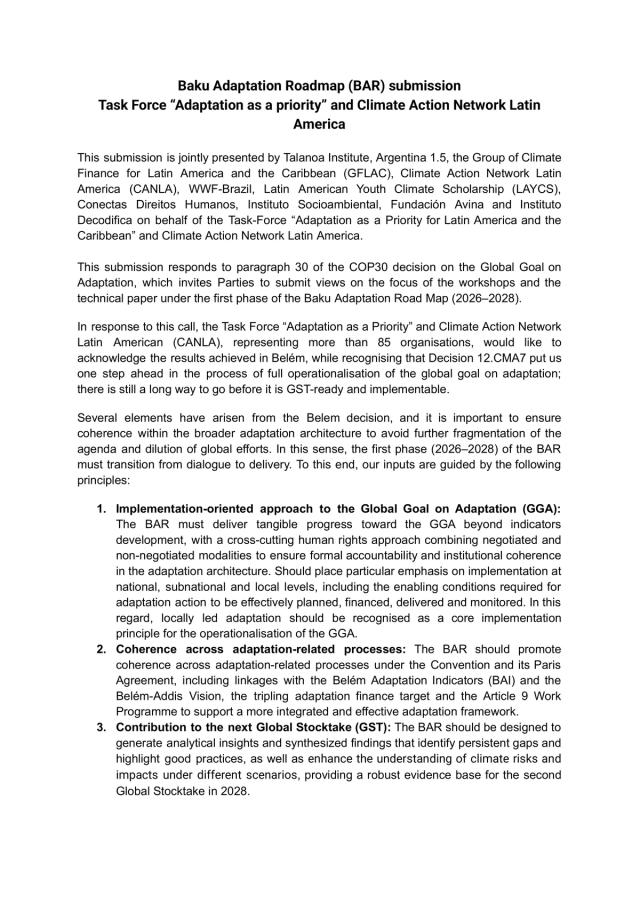
Submission by Task Force «Adaptation as a priority» and CANLA on the Baku Adaptation Roadmap
This submission is jointly presented by Talanoa Institute, Argentina 1.5, the Group of Climate Finance for Latin America and the Caribbean (GFLAC), Climate Action Network Latin America (CANLA), WWF-Brazil, Latin American Youth Climate Scholarship (LAYCS), Conectas Direitos Humanos, Instituto Socioambiental, Fundación Avina, and Instituto Decodifica on behalf of the Task-Force “Adaptation as a Priority for Latin America and the Caribbean” and Climate Action Network Latin America. This submission responds to paragraph 30 of the COP30 decision on the Global Goal on Adaptation, which invites Parties to submit views on the focus of the workshops and the technical paper under the first phase of the Baku Adaptation Road Map (2026–2028).
Submission by Task Force «Adaptation as a priority» and CANLA on the Baku Adaptation Roadmap
This submission is jointly presented by Talanoa Institute, Argentina 1.5, the Group of Climate Finance for Latin America and the Caribbean (GFLAC), Climate Action Network Latin America (CANLA), WWF-Brazil, Latin American Youth Climate Scholarship (LAYCS), Conectas Direitos Humanos, Instituto Socioambiental, Fundación Avina, and Instituto Decodifica on behalf of the Task-Force “Adaptation as a Priority for Latin America and the Caribbean” and Climate Action Network Latin America. This submission responds to paragraph 30 of the COP30 decision on the Global Goal on Adaptation, which invites Parties to submit views on the focus of the workshops and the technical paper under the first phase of the Baku Adaptation Road Map (2026–2028).