
Loading document…
Driving Brazil's Energy Transition: Key Actors, Narratives and Global Commitment (2024-2025)
The year 2025 presents a unique opportunity for Latin America, as Brazil hosts both the annual BRICS Forum summit and the Conference of the Parties (COP30) to the United Nations Framework Convention on Climate Change (UNFCCC), which could foster an energy transition centered on the right to affordable, reliable, clean, and renewable energy. This transition must address the multitude of energy vulnerabilities to avoid exacerbating pre-existing inequalities. This requires a just energy transition grounded in local and community realities and that tackles the effects of climate change from a climate justice perspective. The compatibility of the energy transition imposed on the international agenda with a just transition for developing countries remains a fundamental issue. Conceiving of a just transition solely from a governmental perspective is inherently limiting. Therefore, understanding the role of various actors in advocating for different transition models is crucial, especially for Brazil in 2025. In this context, which Brazilian actors exert significant influence on shaping the national discourse surrounding the energy transition? How are disparate viewpoints reconciled? What discourses dominate Brazilian diplomacy regarding the energy transition at the BRICS Forum, the G20, and the COP? This report aims to identify the main actors influencing discourses on the energy transition in Brazil and analyze their positioning on the international stage.
You may also be interested
GoGoGo to publications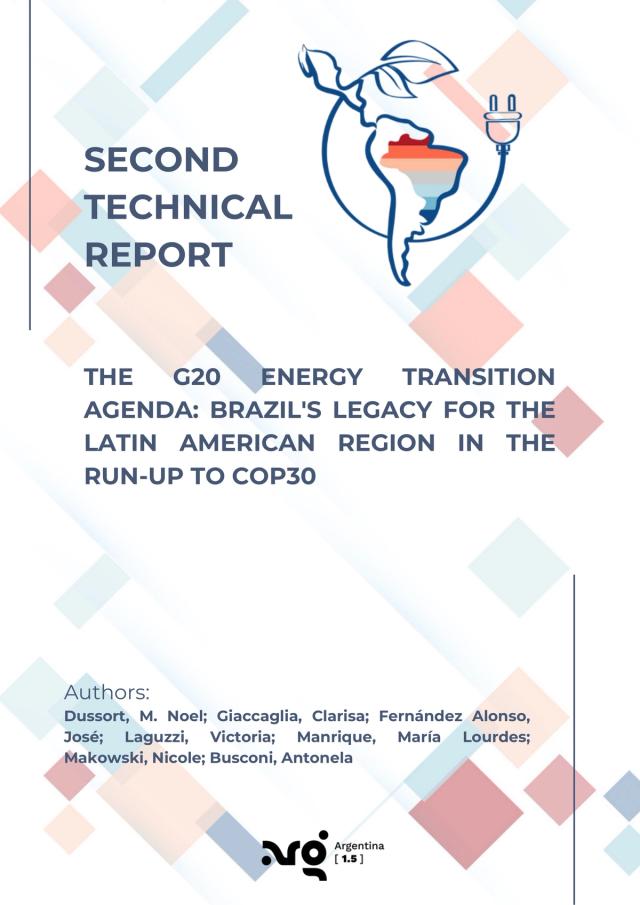
The G20 Energy Transition Agenda: Brazil’s legacy for the Latin America Region in the run-up to COP30
This analysis is informed by the fact that Brazil will hold the presidency of the BRICS Summit and COP30 in 2025, representing a critical opportunity to move towards fairer, more equitable, and democratic energy governance. Brazil has a unique opportunity to build on its previous work in the G20.
The G20 Energy Transition Agenda: Brazil’s legacy for the Latin America Region in the run-up to COP30
This analysis is informed by the fact that Brazil will hold the presidency of the BRICS Summit and COP30 in 2025, representing a critical opportunity to move towards fairer, more equitable, and democratic energy governance. Brazil has a unique opportunity to build on its previous work in the G20.
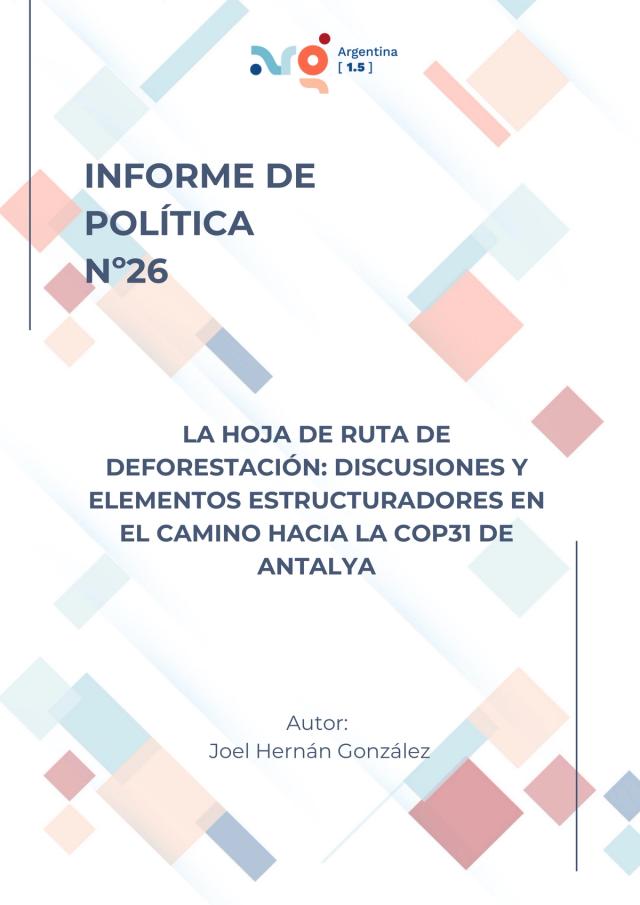
Deforestation Roadmap: discussions and structuring elements on the road to COP31 in Antalya
Forests provide essential ecosystem services for addressing the global environmental and climate crisis. Their capacity to store carbon, regulate hydrological cycles, stabilize regional temperatures, conserve biodiversity, and sustain the livelihoods of millions of people makes them a central component of international mitigation and adaptation strategies. Given their importance, forest management has gained increasing prominence on the international agenda. The most recent effort to revitalize this agenda is the Roadmap to Halt and Reverse Deforestation and Forest Degradation by 2030, launched by the COP30 Presidency in response to paragraphs 33 and 34 of the first Global Stocktake. This Policy Brief aims to briefly reconstruct the evolution of the forest agenda within the UNFCCC; examine the key features of the initiative; and highlight the main elements that emerged from the submissions and discussions held by the Parties. Finally, it is proposed to identify a series of barriers and recommendations associated with them, aimed at strengthening the Leaflet process on the way to the Conference of the Parties (COP31) of the UNFCCC that will take place in Antalya.
Deforestation Roadmap: discussions and structuring elements on the road to COP31 in Antalya
Forests provide essential ecosystem services for addressing the global environmental and climate crisis. Their capacity to store carbon, regulate hydrological cycles, stabilize regional temperatures, conserve biodiversity, and sustain the livelihoods of millions of people makes them a central component of international mitigation and adaptation strategies. Given their importance, forest management has gained increasing prominence on the international agenda. The most recent effort to revitalize this agenda is the Roadmap to Halt and Reverse Deforestation and Forest Degradation by 2030, launched by the COP30 Presidency in response to paragraphs 33 and 34 of the first Global Stocktake. This Policy Brief aims to briefly reconstruct the evolution of the forest agenda within the UNFCCC; examine the key features of the initiative; and highlight the main elements that emerged from the submissions and discussions held by the Parties. Finally, it is proposed to identify a series of barriers and recommendations associated with them, aimed at strengthening the Leaflet process on the way to the Conference of the Parties (COP31) of the UNFCCC that will take place in Antalya.
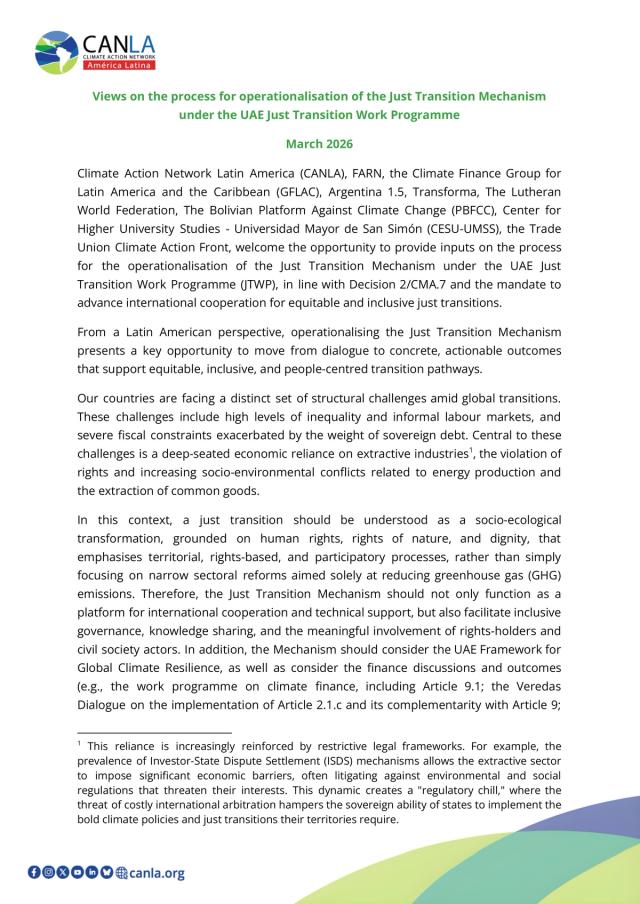
Submission by CAN and CANLA on Views on the process for the operationalisation of the Just Transition Mechanism under the UAE Just Transition Work Programme
Climate Action Network Latin America (CANLA), FARN, the Climate Finance Group for Latin America and the Caribbean (GFLAC), Argentina 1.5, Transforma, The Lutheran World Federation, The Bolivian Platform Against Climate Change (PBFCC), Center for Higher University Studies - Universidad Mayor de San Simón (CESU-UMSS), the Trade Union Climate Action Front, welcome the opportunity to provide inputs on the process for the operationalisation of the Just Transition Mechanism under the UAE Just Transition Work Programme (JTWP), in line with Decision 2/CMA.7 and the mandate to advance international cooperation for equitable and inclusive just transitions.
Submission by CAN and CANLA on Views on the process for the operationalisation of the Just Transition Mechanism under the UAE Just Transition Work Programme
Climate Action Network Latin America (CANLA), FARN, the Climate Finance Group for Latin America and the Caribbean (GFLAC), Argentina 1.5, Transforma, The Lutheran World Federation, The Bolivian Platform Against Climate Change (PBFCC), Center for Higher University Studies - Universidad Mayor de San Simón (CESU-UMSS), the Trade Union Climate Action Front, welcome the opportunity to provide inputs on the process for the operationalisation of the Just Transition Mechanism under the UAE Just Transition Work Programme (JTWP), in line with Decision 2/CMA.7 and the mandate to advance international cooperation for equitable and inclusive just transitions.