
Loading document…
UAE Framework for Global Climate Resilience: key outcomes of COP28 and pathways towards COP29 and COP30
With the completion of the two-year Glasgow-Sharm el-Sheik work programme providing the space to share views and proposals to operationalize the Global Goal on Adaptation, at the United Nations Framework Convention on Climate Change (UNFCCC) COP28, the Parties reached consensus on a Decision, which launched the UAE Framework for Global Climate Resilience. This report aims to analyze the key outcomes of Dubai in relation to the GGA, provide insights about the continuation of the work concerning the new mandates for the UNFCCC bodies, including the modalities of the two-year work programme for developing indicators from UAE to Belém, as well as to explore examples of indicators based on existing work under other international agendas and main challenges and opportunities during 2024 and 2025 negotiations. At the same time, we seek to encourage debate in the adaptation community, in order to foster participatory practices in addressing and determining the indicators that are key to achieving — at least — one of the functions in the purpose of the framework, on reviewing the progress.
You may also be interested
GoGoGo to publications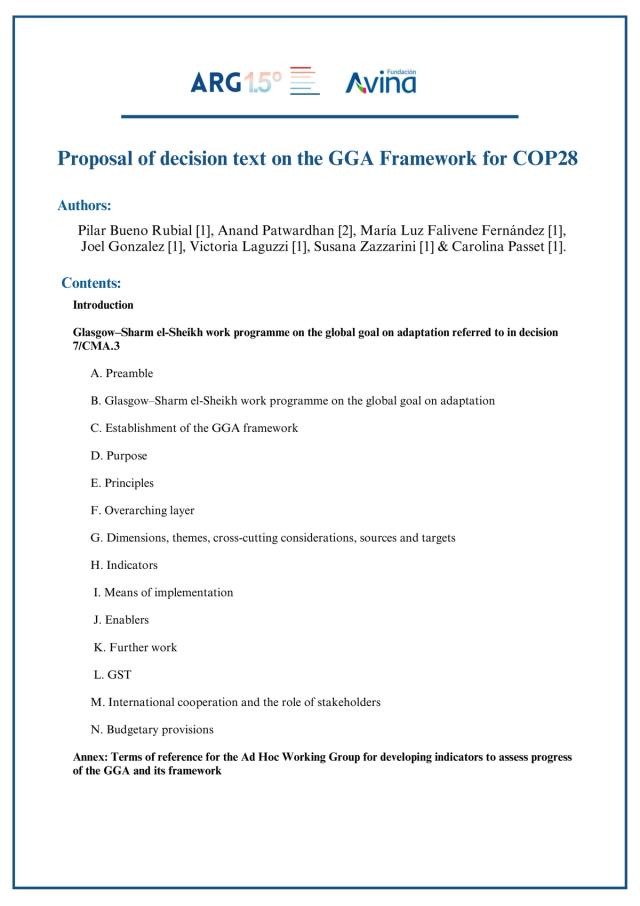
Proposal of decision text on the GGA Framework for COP28
In Sharm el-Sheikh, Parties adopted Decision 3/CMA.4 which decided to initiate the development of a framework for the global goal on adaptation with a view to adopt it in Dubai (COP28). This proposal of decision text seeks to contribute to the efforts of groups, Parties and relevant stakeholders involved in the discussions as well as those interested, to fulfill this mandate at the prompt deliberations in Dubai. This draft decision text includes headings to clearly identify key considerations for a decision on the GGA and its framework, including: preamble (A); taking stock of the GlaSS (B); establishment of the framework (C); elements of the GGA framework (D, E, F, G, H, I, J); further work (H and K); linkages with the GST (L); the role of other stakeholders (M); and budgetary provisions (N). While the headings are intended to be eliminated in the decision, they serve to guide the negotiations.
Proposal of decision text on the GGA Framework for COP28
In Sharm el-Sheikh, Parties adopted Decision 3/CMA.4 which decided to initiate the development of a framework for the global goal on adaptation with a view to adopt it in Dubai (COP28). This proposal of decision text seeks to contribute to the efforts of groups, Parties and relevant stakeholders involved in the discussions as well as those interested, to fulfill this mandate at the prompt deliberations in Dubai. This draft decision text includes headings to clearly identify key considerations for a decision on the GGA and its framework, including: preamble (A); taking stock of the GlaSS (B); establishment of the framework (C); elements of the GGA framework (D, E, F, G, H, I, J); further work (H and K); linkages with the GST (L); the role of other stakeholders (M); and budgetary provisions (N). While the headings are intended to be eliminated in the decision, they serve to guide the negotiations.
Compilation of Illustrative Targets and Indicators for the Global Goal on Adaptation
Submission by the United Nations Foundation, in collaboration with the Adaptation Research Alliance, Adaptation Without Borders, the Alliance for Global Water Adaptation, Argentina 1.5, the Climate Policy Initiative, the International Centre for Integrated Mountain Development, the International Alliance to Combat Ocean Acidification, and the World Resources Institute. The submission was prepared in response to the call for submissions for Workshop 6 of the Glasgow–Sharm el-Sheikh Work Programme on the Global Goal on Adaptation (GGA).
Compilation of Illustrative Targets and Indicators for the Global Goal on Adaptation
Submission by the United Nations Foundation, in collaboration with the Adaptation Research Alliance, Adaptation Without Borders, the Alliance for Global Water Adaptation, Argentina 1.5, the Climate Policy Initiative, the International Centre for Integrated Mountain Development, the International Alliance to Combat Ocean Acidification, and the World Resources Institute. The submission was prepared in response to the call for submissions for Workshop 6 of the Glasgow–Sharm el-Sheikh Work Programme on the Global Goal on Adaptation (GGA).
Testing of the Belém Adaptation Indicators in the Province of Chaco, Argentina. Lessons learned from a multi-scale exercise.
Argentina 1.5 and Gran Chaco Foundations have embarked on a joint journey to contribute to the testing of the BAI from a multi-scalar and multi-level perspective of adaptation. This policy report summarizes the progress made in recent months, which has involved joint capacity building and an effort to understand the extent to which BAI are applicable to the realities of the Chaco province in Argentina, and in particular, to the livestock production chain. To this end, the UAE-FGCR, along with the National Adaptation Plan (NAP) submitted by Argentina to the UNFCCC and the draft Response Plan of the Chaco province under Law 27.520, have been considered as key inputs for the exercise.
Testing of the Belém Adaptation Indicators in the Province of Chaco, Argentina. Lessons learned from a multi-scale exercise.
Argentina 1.5 and Gran Chaco Foundations have embarked on a joint journey to contribute to the testing of the BAI from a multi-scalar and multi-level perspective of adaptation. This policy report summarizes the progress made in recent months, which has involved joint capacity building and an effort to understand the extent to which BAI are applicable to the realities of the Chaco province in Argentina, and in particular, to the livestock production chain. To this end, the UAE-FGCR, along with the National Adaptation Plan (NAP) submitted by Argentina to the UNFCCC and the draft Response Plan of the Chaco province under Law 27.520, have been considered as key inputs for the exercise.