
Loading document…
Submission by CAN and CANLA on Views on the process for the operationalisation of the Just Transition Mechanism under the UAE Just Transition Work Programme
Climate Action Network Latin America (CANLA), FARN, the Climate Finance Group for Latin America and the Caribbean (GFLAC), Argentina 1.5, Transforma, The Lutheran World Federation, The Bolivian Platform Against Climate Change (PBFCC), Center for Higher University Studies - Universidad Mayor de San Simón (CESU-UMSS), the Trade Union Climate Action Front, welcome the opportunity to provide inputs on the process for the operationalisation of the Just Transition Mechanism under the UAE Just Transition Work Programme (JTWP), in line with Decision 2/CMA.7 and the mandate to advance international cooperation for equitable and inclusive just transitions.
You may also be interested
GoGoGo to publications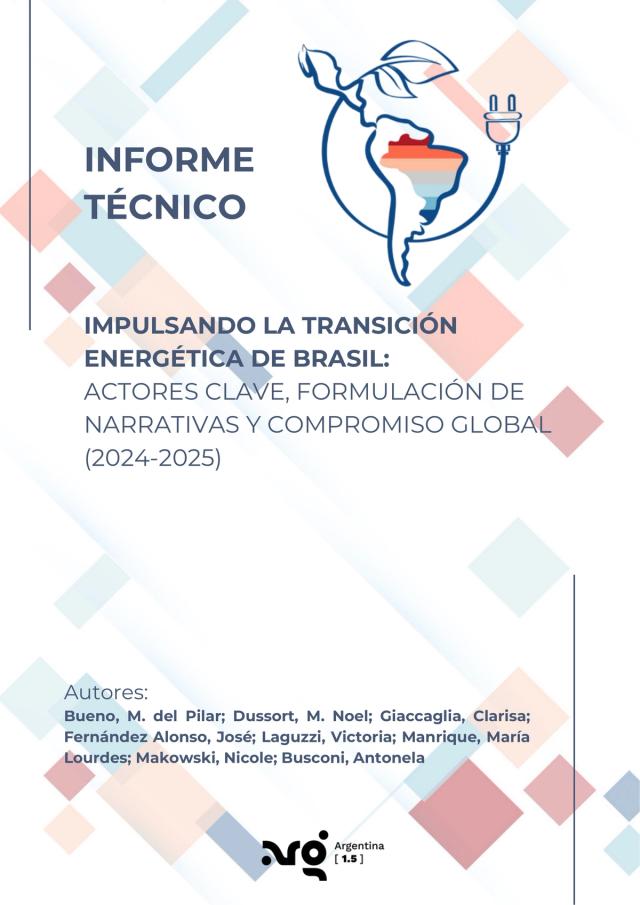
Driving Brazil's Energy Transition: Key Actors, Narratives and Global Commitment (2024-2025)
The year 2025 presents a unique opportunity for Latin America, as Brazil hosts both the annual BRICS Forum summit and the Conference of the Parties (COP30) to the United Nations Framework Convention on Climate Change (UNFCCC), which could foster an energy transition centered on the right to affordable, reliable, clean, and renewable energy. This transition must address the multitude of energy vulnerabilities to avoid exacerbating pre-existing inequalities. This requires a just energy transition grounded in local and community realities and that tackles the effects of climate change from a climate justice perspective. The compatibility of the energy transition imposed on the international agenda with a just transition for developing countries remains a fundamental issue. Conceiving of a just transition solely from a governmental perspective is inherently limiting. Therefore, understanding the role of various actors in advocating for different transition models is crucial, especially for Brazil in 2025. In this context, which Brazilian actors exert significant influence on shaping the national discourse surrounding the energy transition? How are disparate viewpoints reconciled? What discourses dominate Brazilian diplomacy regarding the energy transition at the BRICS Forum, the G20, and the COP? This report aims to identify the main actors influencing discourses on the energy transition in Brazil and analyze their positioning on the international stage.
Driving Brazil's Energy Transition: Key Actors, Narratives and Global Commitment (2024-2025)
The year 2025 presents a unique opportunity for Latin America, as Brazil hosts both the annual BRICS Forum summit and the Conference of the Parties (COP30) to the United Nations Framework Convention on Climate Change (UNFCCC), which could foster an energy transition centered on the right to affordable, reliable, clean, and renewable energy. This transition must address the multitude of energy vulnerabilities to avoid exacerbating pre-existing inequalities. This requires a just energy transition grounded in local and community realities and that tackles the effects of climate change from a climate justice perspective. The compatibility of the energy transition imposed on the international agenda with a just transition for developing countries remains a fundamental issue. Conceiving of a just transition solely from a governmental perspective is inherently limiting. Therefore, understanding the role of various actors in advocating for different transition models is crucial, especially for Brazil in 2025. In this context, which Brazilian actors exert significant influence on shaping the national discourse surrounding the energy transition? How are disparate viewpoints reconciled? What discourses dominate Brazilian diplomacy regarding the energy transition at the BRICS Forum, the G20, and the COP? This report aims to identify the main actors influencing discourses on the energy transition in Brazil and analyze their positioning on the international stage.
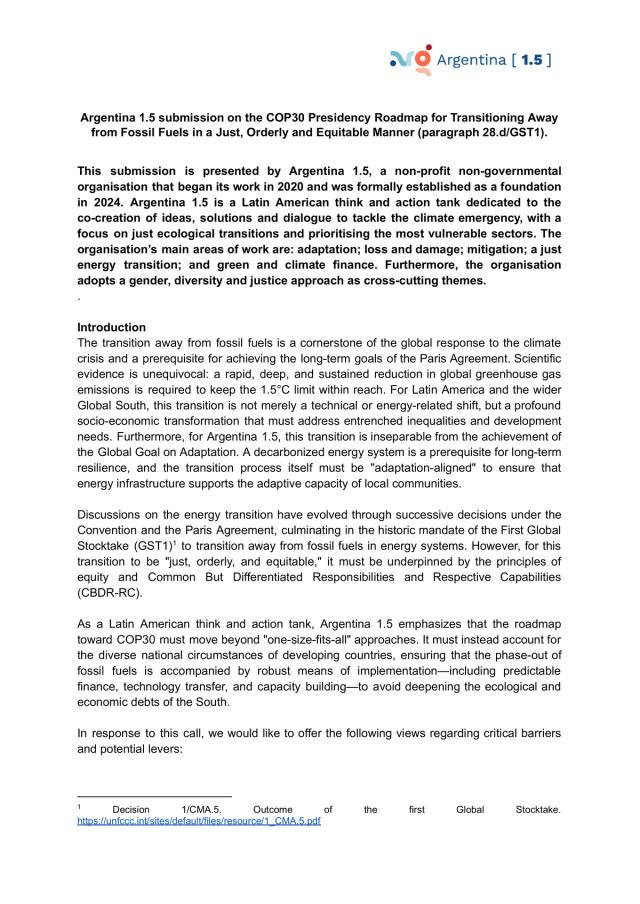
Argentina 1.5 submission on the COP30 Presidency Roadmap for Transitioning Away from Fossil Fuels in a just, orderly and equitable manner (paragraph 28.d/GST1)
This submission is presented by Argentina 1.5, a non-profit non-governmental organisation that began its work in 2020 and was formally established as a foundation in 2024. Argentina 1.5 is a Latin American think and action tank dedicated to the co-creation of ideas, solutions and dialogue to tackle the climate emergency, with a focus on just ecological transitions and prioritising the most vulnerable sectors. The organisation’s main areas of work are: adaptation; loss and damage; mitigation; a just energy transition; and green and climate finance. Furthermore, the organisation adopts a gender, diversity and justice approach as cross-cutting themes.
Argentina 1.5 submission on the COP30 Presidency Roadmap for Transitioning Away from Fossil Fuels in a just, orderly and equitable manner (paragraph 28.d/GST1)
This submission is presented by Argentina 1.5, a non-profit non-governmental organisation that began its work in 2020 and was formally established as a foundation in 2024. Argentina 1.5 is a Latin American think and action tank dedicated to the co-creation of ideas, solutions and dialogue to tackle the climate emergency, with a focus on just ecological transitions and prioritising the most vulnerable sectors. The organisation’s main areas of work are: adaptation; loss and damage; mitigation; a just energy transition; and green and climate finance. Furthermore, the organisation adopts a gender, diversity and justice approach as cross-cutting themes.
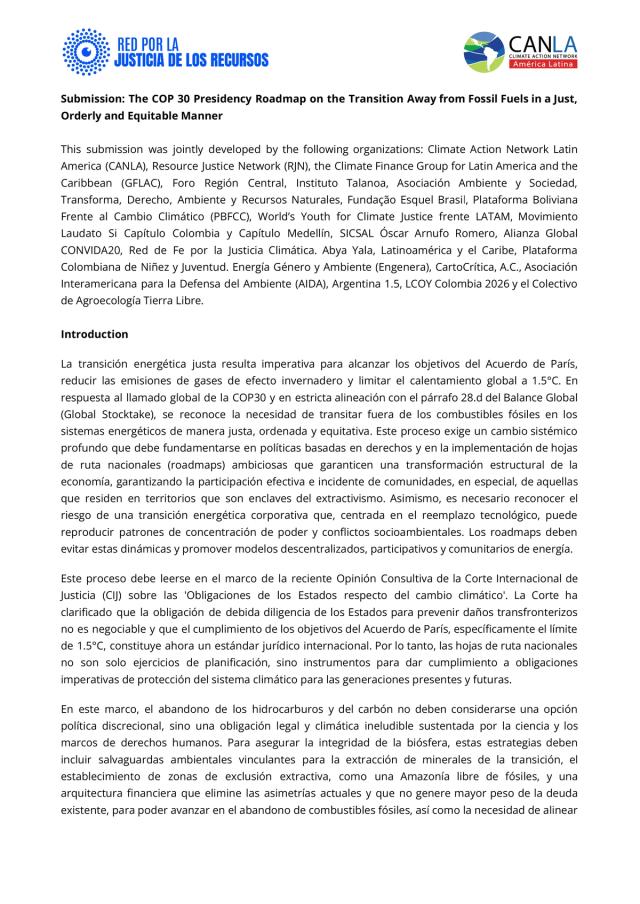
Submission: The COP 30 Presidency Roadmap on the Transition Away from Fossil Fuels in a just, orderly and equitable manner
This submission was jointly developed by the following organizations: Climate Action Network Latin America (CANLA), Resource Justice Network (RJN), the Climate Finance Group for Latin America and the Caribbean (GFLAC), Foro Región Central, Instituto Talanoa, Asociación Ambiente y Sociedad, Transforma, Derecho, Ambiente y Recursos Naturales, Fundação Esquel Brasil, Plataforma Boliviana Frente al Cambio Climático (PBFCC), World’s Youth for Climate Justice frente LATAM, Movimiento Laudato Si Capítulo Colombia y Capítulo Medellín, SICSAL Óscar Arnufo Romero, Alianza Global CONVIDA20, Red de Fe por la Justicia Climática. Abya Yala, Latinoamérica y el Caribe, Plataforma Colombiana de Niñez y Juventud. Energía Género y Ambiente (Engenera), CartoCrítica, A.C., Asociación Interamericana para la Defensa del Ambiente (AIDA), Argentina 1.5, LCOY Colombia 2026 y el Colectivo de Agroecología Tierra Libre to the COP 30 Presidency Roadmap on the Transition Away from Fossil Fuels in a Just, Orderly and Equitable Manner.
Submission: The COP 30 Presidency Roadmap on the Transition Away from Fossil Fuels in a just, orderly and equitable manner
This submission was jointly developed by the following organizations: Climate Action Network Latin America (CANLA), Resource Justice Network (RJN), the Climate Finance Group for Latin America and the Caribbean (GFLAC), Foro Región Central, Instituto Talanoa, Asociación Ambiente y Sociedad, Transforma, Derecho, Ambiente y Recursos Naturales, Fundação Esquel Brasil, Plataforma Boliviana Frente al Cambio Climático (PBFCC), World’s Youth for Climate Justice frente LATAM, Movimiento Laudato Si Capítulo Colombia y Capítulo Medellín, SICSAL Óscar Arnufo Romero, Alianza Global CONVIDA20, Red de Fe por la Justicia Climática. Abya Yala, Latinoamérica y el Caribe, Plataforma Colombiana de Niñez y Juventud. Energía Género y Ambiente (Engenera), CartoCrítica, A.C., Asociación Interamericana para la Defensa del Ambiente (AIDA), Argentina 1.5, LCOY Colombia 2026 y el Colectivo de Agroecología Tierra Libre to the COP 30 Presidency Roadmap on the Transition Away from Fossil Fuels in a Just, Orderly and Equitable Manner.