

Research
to turn
evidence into action
Explore reports, technical documents and publications that aim to strengthen climate policies at the subnational, national and international levels, promoting the development of the most vulnerable communities.
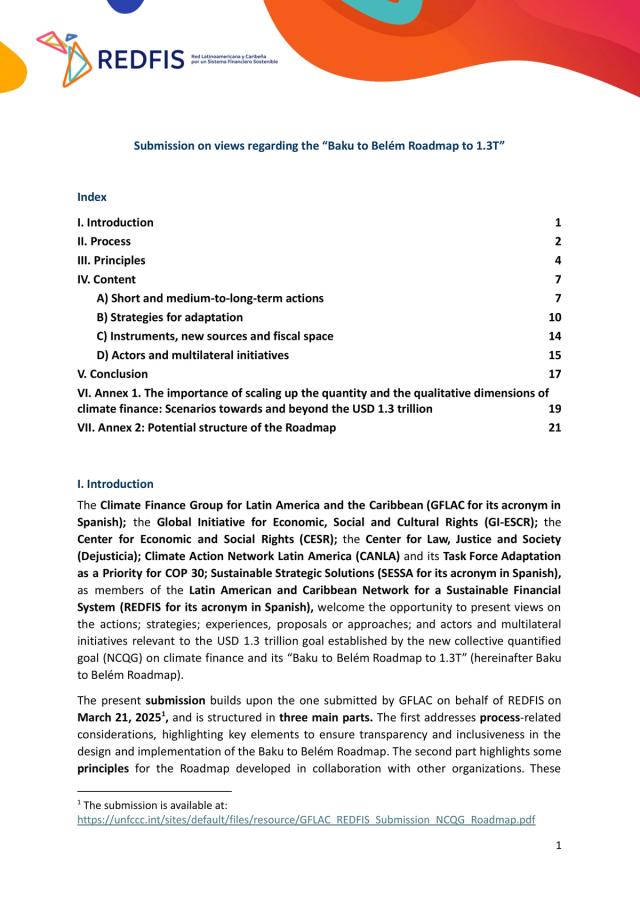
Submission by REDFIS on views regarding the “Baku to Belém Roadmap to 1.3T”- Second round
REDFIS
Submission by REDFIS on views regarding the “Baku to Belém Roadmap to 1.3T”- Second round
REDFIS
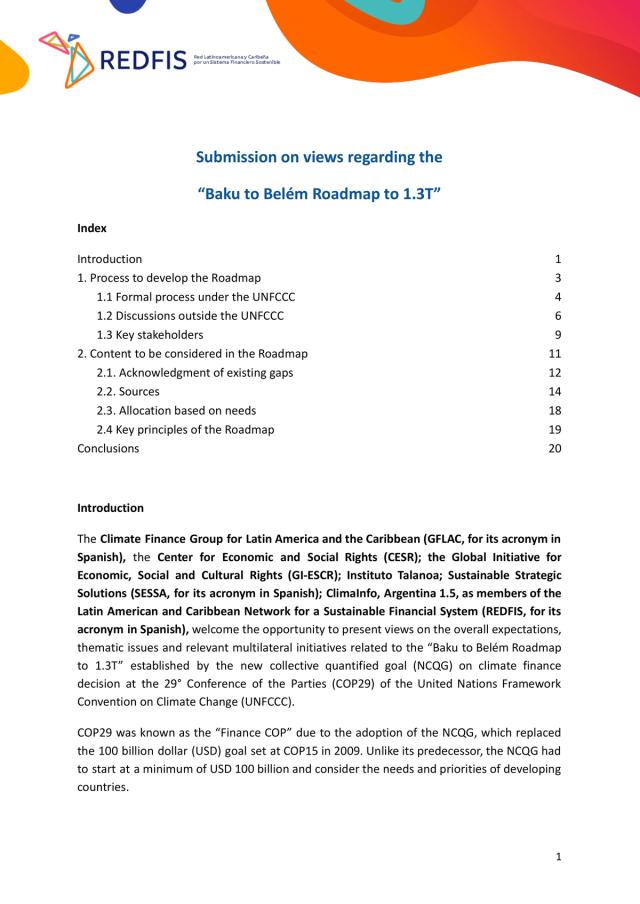
Submission by REDFIS on views regarding the Baku to Belém Roadmap to 1.3T. First round
REDFIS
Submission by REDFIS on views regarding the Baku to Belém Roadmap to 1.3T. First round
REDFIS
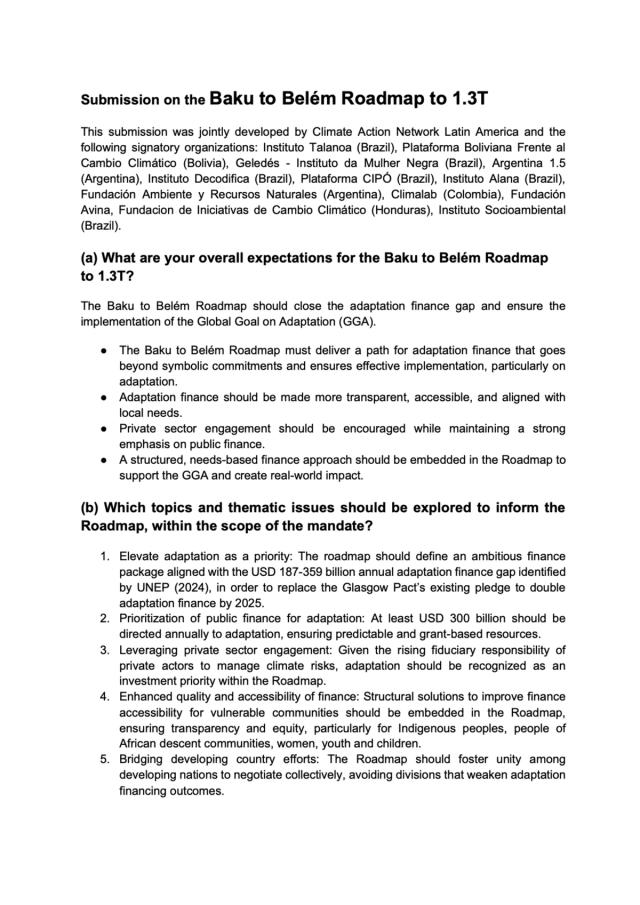
Submission from Climate Action Network Latin America (CANLA) on the Baku to Belém Roadmap to 1.3T
This submission was jointly developed by Climate Action Network Latin America and the following signatory organizations: Instituto Talanoa (Brazil), Plataforma Boliviana Frente al Cambio Climático (Bolivia), Geledés – Instituto da Mulher Negra (Brazil), Argentina 1.5 (Argentina), Instituto Decodifica (Brazil), Plataforma CIPÓ (Brazil), Instituto Alana (Brazil), Fundación Ambiente y Recursos Naturales (Argentina), Climalab (Colombia), Fundación Avina, Fundacion de Iniciativas de Cambio Climático (Honduras), Instituto Socioambiental (Brazil) on the Baku to Belém Roadmap to 1.3T.
Submission from Climate Action Network Latin America (CANLA) on the Baku to Belém Roadmap to 1.3T
This submission was jointly developed by Climate Action Network Latin America and the following signatory organizations: Instituto Talanoa (Brazil), Plataforma Boliviana Frente al Cambio Climático (Bolivia), Geledés – Instituto da Mulher Negra (Brazil), Argentina 1.5 (Argentina), Instituto Decodifica (Brazil), Plataforma CIPÓ (Brazil), Instituto Alana (Brazil), Fundación Ambiente y Recursos Naturales (Argentina), Climalab (Colombia), Fundación Avina, Fundacion de Iniciativas de Cambio Climático (Honduras), Instituto Socioambiental (Brazil) on the Baku to Belém Roadmap to 1.3T.
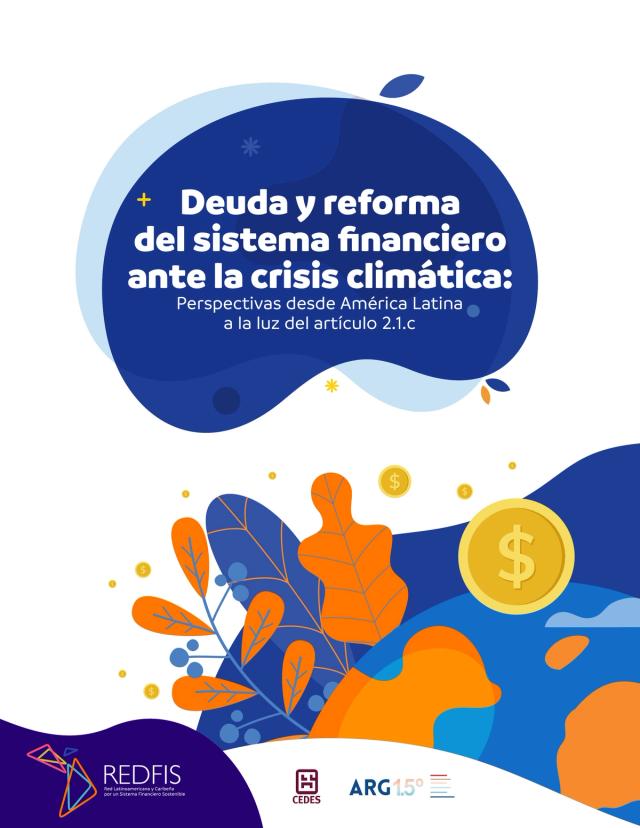
Debt and financial system reform in the face of the climate crisis: Perspectives from Latin America
This document aims to analyze the scope and challenges of addressing the issue of sovereign debt within the framework of Article 2.1.c of the Paris Agreement. The work presented here is based on the premise that analyzing the treatment of sovereign debt under Article 2.1.c becomes crucial in light of the tensions that have arisen—and continue to arise—among different countries regarding the diagnosis (and solution) of debt crises and the scope and implementation of the aforementioned article in matters of sovereign debt.
Debt and financial system reform in the face of the climate crisis: Perspectives from Latin America
This document aims to analyze the scope and challenges of addressing the issue of sovereign debt within the framework of Article 2.1.c of the Paris Agreement. The work presented here is based on the premise that analyzing the treatment of sovereign debt under Article 2.1.c becomes crucial in light of the tensions that have arisen—and continue to arise—among different countries regarding the diagnosis (and solution) of debt crises and the scope and implementation of the aforementioned article in matters of sovereign debt.
Position paper of Latin American and Caribbean organizations towards the Summit “For a New Global Pact on Financing”
The Climate Finance Group for Latin America and the Caribbean (GFLAC) on behalf of: Pachamama Foundation, Hivos, Mexican Center for Environmental Law (CEMDA), Argentina 1.5, Latin American Observatory for Climate Action (OLAC), CAMBIUM and Barranquilla +20. Presentation made following the invitation of the Third Conference of the Parties to the Paris Agreement for the definition of a New Quantified Collective Target on climate finance in 2025.
Position paper of Latin American and Caribbean organizations towards the Summit “For a New Global Pact on Financing”
The Climate Finance Group for Latin America and the Caribbean (GFLAC) on behalf of: Pachamama Foundation, Hivos, Mexican Center for Environmental Law (CEMDA), Argentina 1.5, Latin American Observatory for Climate Action (OLAC), CAMBIUM and Barranquilla +20. Presentation made following the invitation of the Third Conference of the Parties to the Paris Agreement for the definition of a New Quantified Collective Target on climate finance in 2025.
Regulatory and institutional regressions in environmental and climate governance in Argentina
Since December 2023, Argentina has been undergoing a period of debate and transformation in its environmental and climate policy, characterized by institutional reforms and a weakening of protection standards, which puts it at odds with the principle of non-regression. Among the main changes are the reduction of the institutional scope of the national environmental and climate sector, budget cuts, proposals to relax regulations related to the management and exploitation of natural resources and extractive activities, and changes to the system of minimum environmental standards. One of the most relevant debates is the reform of legislation protecting glaciers and the periglacial environment, which has been heavily criticized for the substantial modifications it introduces, primarily the restriction of protected areas and the transfer of regulatory powers to the provinces, with direct impacts on national climate policy. The tensions arising from deregulation processes, increasing demands for environmental protection, and the need to uphold international commitments made in the face of the climate crisis highlight the need to strengthen institutional capacities, guarantee minimum environmental protection standards, and consolidate effective governance mechanisms.
Regulatory and institutional regressions in environmental and climate governance in Argentina
Since December 2023, Argentina has been undergoing a period of debate and transformation in its environmental and climate policy, characterized by institutional reforms and a weakening of protection standards, which puts it at odds with the principle of non-regression. Among the main changes are the reduction of the institutional scope of the national environmental and climate sector, budget cuts, proposals to relax regulations related to the management and exploitation of natural resources and extractive activities, and changes to the system of minimum environmental standards. One of the most relevant debates is the reform of legislation protecting glaciers and the periglacial environment, which has been heavily criticized for the substantial modifications it introduces, primarily the restriction of protected areas and the transfer of regulatory powers to the provinces, with direct impacts on national climate policy. The tensions arising from deregulation processes, increasing demands for environmental protection, and the need to uphold international commitments made in the face of the climate crisis highlight the need to strengthen institutional capacities, guarantee minimum environmental protection standards, and consolidate effective governance mechanisms.