
Loading document…
Shaping Brazil´s energy transition: key actors, narrative and global engagement (2024-2025)
Brazil stands at a crucial juncture: either perpetuating the mainstream energy transition championed by the world’s largest energy-consuming nations, positioning the Global South as a reservoir of critical minerals and a transitional supplier of fossil fuels, as well as a provider of raw materials, or spearheading a just transition. A just energy transition entails decarbonizing economies and safeguarding biomes for future generations, while also potentially fostering a more autonomous approach to the transition within an unfavorable international geopolitical context. Conceiving of a just transition solely from a governmental perspective is inherently limited. Therefore, understanding the roles of diverse stakeholders in advocating for different transition models is paramount, particularly for Brazil this year. Within this context, which Brazilian stakeholders exert significant influence in shaping the domestic narrative surrounding the energy transition? How are disparate viewpoints reconciled? What narratives dominate Brazilian diplomacy regarding the energy transition within the BRICS Forum, the G20, and the COP? This report endeavors to identify the key stakeholders influencing energy transition narratives in Brazil and analyze their positioning on the international stage.
You may also be interested
GoGoGo to publications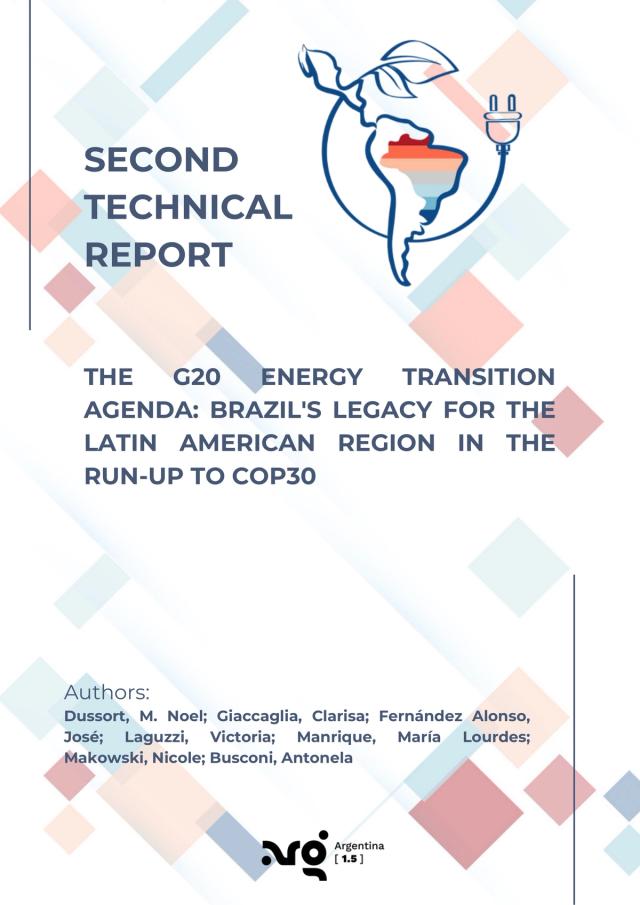
The G20 Energy Transition Agenda: Brazil’s legacy for the Latin America Region in the run-up to COP30
This analysis is informed by the fact that Brazil will hold the presidency of the BRICS Summit and COP30 in 2025, representing a critical opportunity to move towards fairer, more equitable, and democratic energy governance. Brazil has a unique opportunity to build on its previous work in the G20.
The G20 Energy Transition Agenda: Brazil’s legacy for the Latin America Region in the run-up to COP30
This analysis is informed by the fact that Brazil will hold the presidency of the BRICS Summit and COP30 in 2025, representing a critical opportunity to move towards fairer, more equitable, and democratic energy governance. Brazil has a unique opportunity to build on its previous work in the G20.
Towards an equitable Global Stocktake: recommendations from Latin America and the Caribbean for the adaptation agenda in the second Global Stocktake
The project "Strengthening the Perspectives of Latin America and the Caribbean in the Assessment of Progress on Adaptation in the Second Global Stocktake", promoted by Argentina 1.5 and the Adaptation Research Alliance (ARA), aimed to deepen the analysis of the gaps identified in the first Global Stocktake, with special attention to the adaptation mandates of Article 7.14 of the Paris Agreement. Based on this analysis, the project sought to generate concrete regional inputs, supported by empirical evidence, to contribute to the second Global Stocktake process. Within this framework, the proposal created spaces for exchange and the substantive participation of key organizations and actors from Latin America and the Caribbean through three virtual workshops, a webinar, and a meeting with negotiators and representatives of civil society organizations during the 64th meeting of the UNFCCC subsidiary bodies. These spaces allowed for an analysis of the evolution of adaptation mandates within the Global Stocktake framework and the identification of critical gaps. This document synthesizes the evidence obtained throughout the various stages of the project, which has been used to develop recommendations and policy messages that contribute to the global process under the UNFCCC.
Towards an equitable Global Stocktake: recommendations from Latin America and the Caribbean for the adaptation agenda in the second Global Stocktake
The project "Strengthening the Perspectives of Latin America and the Caribbean in the Assessment of Progress on Adaptation in the Second Global Stocktake", promoted by Argentina 1.5 and the Adaptation Research Alliance (ARA), aimed to deepen the analysis of the gaps identified in the first Global Stocktake, with special attention to the adaptation mandates of Article 7.14 of the Paris Agreement. Based on this analysis, the project sought to generate concrete regional inputs, supported by empirical evidence, to contribute to the second Global Stocktake process. Within this framework, the proposal created spaces for exchange and the substantive participation of key organizations and actors from Latin America and the Caribbean through three virtual workshops, a webinar, and a meeting with negotiators and representatives of civil society organizations during the 64th meeting of the UNFCCC subsidiary bodies. These spaces allowed for an analysis of the evolution of adaptation mandates within the Global Stocktake framework and the identification of critical gaps. This document synthesizes the evidence obtained throughout the various stages of the project, which has been used to develop recommendations and policy messages that contribute to the global process under the UNFCCC.
Collective assessment of adaptation from the first to the second Global Stocktake: state of play
The Paris Agreement establishes the Global Stocktake as a periodic mechanism to determine collective progress toward achieving long-term goals. The Global Stocktake is a facilitative process that involves all components of the Agreement—mitigation, adaptation, loss and damage, and means of implementation— in light of equity and the best available scientific information. At the same time, the Paris Agreement establishes a set of key aspects regarding the collective assessment of adaptation progress in the Global Stocktake in Article 7.14. However, the first Global Stocktake (GST1) highlighted the persistent political and technical obstacles that marginalize adaptation in international climate governance. Specifically, the fundamental mandates of this Article faced significant implementation dilemmas, resulting in a limited depth of this collective assessment of adaptation. There is a risk that these scenarios will be repeated in the second Global Stocktake (GST2), which begins this year. This synthesis report is part of a project by Argentina 1.5 and supported by the Adaptation Research Alliance that seeks to strengthen the understanding of the gaps identified in GST1, paying special attention to the mandates on adaptation, with a view to generating evidence-based proposals from Latin America and the Caribbean towards GST2.
Collective assessment of adaptation from the first to the second Global Stocktake: state of play
The Paris Agreement establishes the Global Stocktake as a periodic mechanism to determine collective progress toward achieving long-term goals. The Global Stocktake is a facilitative process that involves all components of the Agreement—mitigation, adaptation, loss and damage, and means of implementation— in light of equity and the best available scientific information. At the same time, the Paris Agreement establishes a set of key aspects regarding the collective assessment of adaptation progress in the Global Stocktake in Article 7.14. However, the first Global Stocktake (GST1) highlighted the persistent political and technical obstacles that marginalize adaptation in international climate governance. Specifically, the fundamental mandates of this Article faced significant implementation dilemmas, resulting in a limited depth of this collective assessment of adaptation. There is a risk that these scenarios will be repeated in the second Global Stocktake (GST2), which begins this year. This synthesis report is part of a project by Argentina 1.5 and supported by the Adaptation Research Alliance that seeks to strengthen the understanding of the gaps identified in GST1, paying special attention to the mandates on adaptation, with a view to generating evidence-based proposals from Latin America and the Caribbean towards GST2.