
Loading document…
Key political messages to support an ambitious decision on the GGA at COP28
UNFCCC COP28 is a turning point to show global leadership on adaptation, not only because risks and impacts continue to increase as global warming intensifies, but also because soft limits to adaptation have already been reached and avoiding hard limits can result in fewer losses and damages. However, the window of opportunity for both mitigation and adaptation is becoming narrower. We need a shift to accelerate transformative action if we are to achieve climate-resilient development. But the absence of a global framework to scale action and support protecting people, livelihoods, and ecosystems puts us at risk of investing in maladaptive pathways and counterproductive initiatives. The GGA framework aims to provide a political and methodological tool that can offer high-level targets, equipping us to assess progress.
You may also be interested
GoGoGo to publications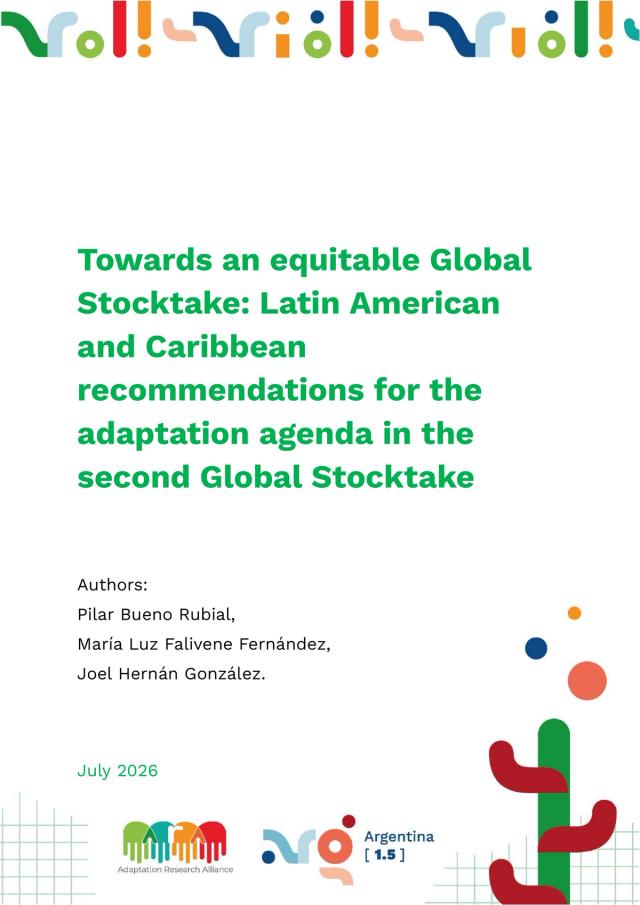
Towards an equitable Global Stocktake: recommendations from Latin America and the Caribbean for the adaptation agenda in the second Global Stocktake
The project "Strengthening the Perspectives of Latin America and the Caribbean in the Assessment of Progress on Adaptation in the Second Global Stocktake", promoted by Argentina 1.5 and the Adaptation Research Alliance (ARA), aimed to deepen the analysis of the gaps identified in the first Global Stocktake, with special attention to the adaptation mandates of Article 7.14 of the Paris Agreement. Based on this analysis, the project sought to generate concrete regional inputs, supported by empirical evidence, to contribute to the second Global Stocktake process. Within this framework, the proposal created spaces for exchange and the substantive participation of key organizations and actors from Latin America and the Caribbean through three virtual workshops, a webinar, and a meeting with negotiators and representatives of civil society organizations during the 64th meeting of the UNFCCC subsidiary bodies. These spaces allowed for an analysis of the evolution of adaptation mandates within the Global Stocktake framework and the identification of critical gaps. This document synthesizes the evidence obtained throughout the various stages of the project, which has been used to develop recommendations and policy messages that contribute to the global process under the UNFCCC.
Towards an equitable Global Stocktake: recommendations from Latin America and the Caribbean for the adaptation agenda in the second Global Stocktake
The project "Strengthening the Perspectives of Latin America and the Caribbean in the Assessment of Progress on Adaptation in the Second Global Stocktake", promoted by Argentina 1.5 and the Adaptation Research Alliance (ARA), aimed to deepen the analysis of the gaps identified in the first Global Stocktake, with special attention to the adaptation mandates of Article 7.14 of the Paris Agreement. Based on this analysis, the project sought to generate concrete regional inputs, supported by empirical evidence, to contribute to the second Global Stocktake process. Within this framework, the proposal created spaces for exchange and the substantive participation of key organizations and actors from Latin America and the Caribbean through three virtual workshops, a webinar, and a meeting with negotiators and representatives of civil society organizations during the 64th meeting of the UNFCCC subsidiary bodies. These spaces allowed for an analysis of the evolution of adaptation mandates within the Global Stocktake framework and the identification of critical gaps. This document synthesizes the evidence obtained throughout the various stages of the project, which has been used to develop recommendations and policy messages that contribute to the global process under the UNFCCC.
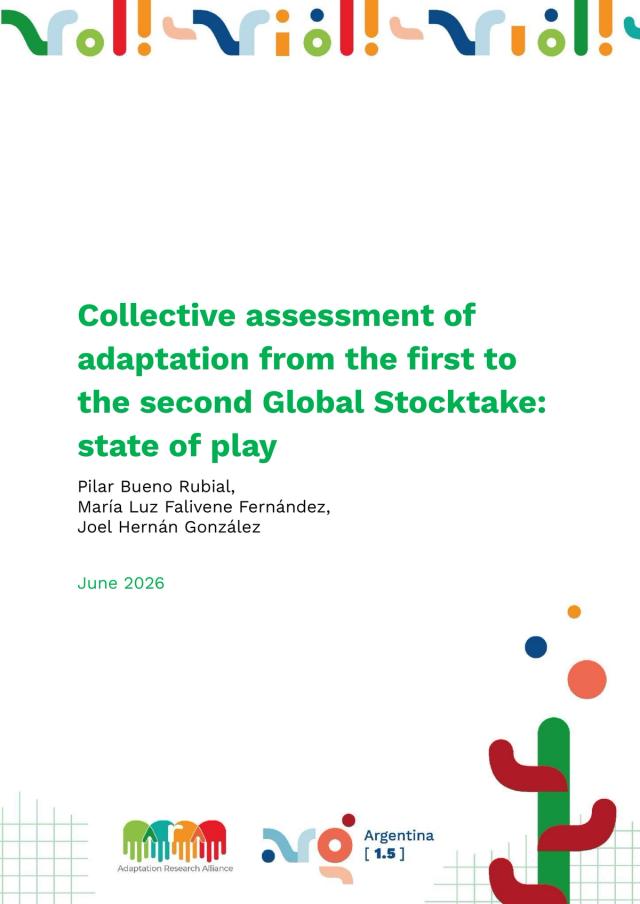
Collective assessment of adaptation from the first to the second Global Stocktake: state of play
The Paris Agreement establishes the Global Stocktake as a periodic mechanism to determine collective progress toward achieving long-term goals. The Global Stocktake is a facilitative process that involves all components of the Agreement—mitigation, adaptation, loss and damage, and means of implementation— in light of equity and the best available scientific information. At the same time, the Paris Agreement establishes a set of key aspects regarding the collective assessment of adaptation progress in the Global Stocktake in Article 7.14. However, the first Global Stocktake (GST1) highlighted the persistent political and technical obstacles that marginalize adaptation in international climate governance. Specifically, the fundamental mandates of this Article faced significant implementation dilemmas, resulting in a limited depth of this collective assessment of adaptation. There is a risk that these scenarios will be repeated in the second Global Stocktake (GST2), which begins this year. This synthesis report is part of a project by Argentina 1.5 and supported by the Adaptation Research Alliance that seeks to strengthen the understanding of the gaps identified in GST1, paying special attention to the mandates on adaptation, with a view to generating evidence-based proposals from Latin America and the Caribbean towards GST2.
Collective assessment of adaptation from the first to the second Global Stocktake: state of play
The Paris Agreement establishes the Global Stocktake as a periodic mechanism to determine collective progress toward achieving long-term goals. The Global Stocktake is a facilitative process that involves all components of the Agreement—mitigation, adaptation, loss and damage, and means of implementation— in light of equity and the best available scientific information. At the same time, the Paris Agreement establishes a set of key aspects regarding the collective assessment of adaptation progress in the Global Stocktake in Article 7.14. However, the first Global Stocktake (GST1) highlighted the persistent political and technical obstacles that marginalize adaptation in international climate governance. Specifically, the fundamental mandates of this Article faced significant implementation dilemmas, resulting in a limited depth of this collective assessment of adaptation. There is a risk that these scenarios will be repeated in the second Global Stocktake (GST2), which begins this year. This synthesis report is part of a project by Argentina 1.5 and supported by the Adaptation Research Alliance that seeks to strengthen the understanding of the gaps identified in GST1, paying special attention to the mandates on adaptation, with a view to generating evidence-based proposals from Latin America and the Caribbean towards GST2.
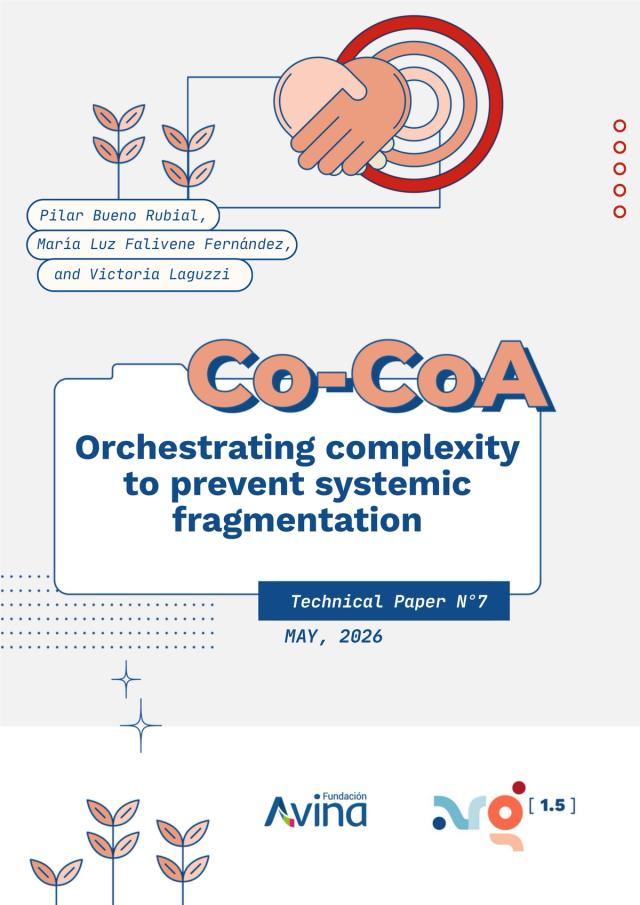
Orchestrating complexity to prevent systemic fragmentation
As the international community moves from negotiation to implementation, one key challenge is translating global indicators into actionable, context-relevant monitoring systems at the national and subnational levels. In this regard, CoCoA “Collective Construction of Adaptation Indicators”, contributes with a bottom-up perspective by engaging civil society organisations, local actors, and technical experts across Latin America and the Caribbean to reflect on how adaptation indicators can be operationalised in real-world contexts. This approach helps bridge the gap between global methodological discussions and the realities of data availability, institutional capacities, and locally identified adaptation priorities. As a two-way learning process, CoCoA brings information on adaptation negotiations closer to communities and, at the same time, serves as a bridge connecting local and community experiences to the international level. To contribute to this process, this report provides updated information on recent developments in the negotiations and their main challenges leading up to the next sessions. It focuses on the COP30 process and outcomes on adaptation and the challenges they pose for accelerated implementation. Therefore, it is of particular interest to examine orchestration processes as a way to understand the interrelationships within and between climate regimes in a world where geopolitical threats have multiplied.
Orchestrating complexity to prevent systemic fragmentation
As the international community moves from negotiation to implementation, one key challenge is translating global indicators into actionable, context-relevant monitoring systems at the national and subnational levels. In this regard, CoCoA “Collective Construction of Adaptation Indicators”, contributes with a bottom-up perspective by engaging civil society organisations, local actors, and technical experts across Latin America and the Caribbean to reflect on how adaptation indicators can be operationalised in real-world contexts. This approach helps bridge the gap between global methodological discussions and the realities of data availability, institutional capacities, and locally identified adaptation priorities. As a two-way learning process, CoCoA brings information on adaptation negotiations closer to communities and, at the same time, serves as a bridge connecting local and community experiences to the international level. To contribute to this process, this report provides updated information on recent developments in the negotiations and their main challenges leading up to the next sessions. It focuses on the COP30 process and outcomes on adaptation and the challenges they pose for accelerated implementation. Therefore, it is of particular interest to examine orchestration processes as a way to understand the interrelationships within and between climate regimes in a world where geopolitical threats have multiplied.