
Loading document…
Setting up a Framework for the Global Goal on Adaptation: Progress Made in Botswana and Proposals
This report provides a state of play after Botswana ́s workshop. At the same time, and based on our previous report, a traffic light exercise assesses the degree of convergence or divergence of positions on the issues that would potentially be included in the GGA decision this year. Compared to the previous report, further elaboration has been done for some of the issues to better understand the points where positions still need to be brought closer together. The aim of our report is to support the consultation process prior to COP28 in order to achieve the best possible outcome in Dubai for a long-discussed issue that still faces methodological, empirical, conceptual and political challenges (UNFCCC, 2021), but which is essential for accelerating and scaling action on adaptation.
You may also be interested
GoGoGo to publications
Orchestrating complexity to prevent systemic fragmentation
As the international community moves from negotiation to implementation, one key challenge is translating global indicators into actionable, context-relevant monitoring systems at the national and subnational levels. In this regard, CoCoA “Collective Construction of Adaptation Indicators”, contributes with a bottom-up perspective by engaging civil society organisations, local actors, and technical experts across Latin America and the Caribbean to reflect on how adaptation indicators can be operationalised in real-world contexts. This approach helps bridge the gap between global methodological discussions and the realities of data availability, institutional capacities, and locally identified adaptation priorities. As a two-way learning process, CoCoA brings information on adaptation negotiations closer to communities and, at the same time, serves as a bridge connecting local and community experiences to the international level. To contribute to this process, this report provides updated information on recent developments in the negotiations and their main challenges leading up to the next sessions. It focuses on the COP30 process and outcomes on adaptation and the challenges they pose for accelerated implementation. Therefore, it is of particular interest to examine orchestration processes as a way to understand the interrelationships within and between climate regimes in a world where geopolitical threats have multiplied.
Orchestrating complexity to prevent systemic fragmentation
As the international community moves from negotiation to implementation, one key challenge is translating global indicators into actionable, context-relevant monitoring systems at the national and subnational levels. In this regard, CoCoA “Collective Construction of Adaptation Indicators”, contributes with a bottom-up perspective by engaging civil society organisations, local actors, and technical experts across Latin America and the Caribbean to reflect on how adaptation indicators can be operationalised in real-world contexts. This approach helps bridge the gap between global methodological discussions and the realities of data availability, institutional capacities, and locally identified adaptation priorities. As a two-way learning process, CoCoA brings information on adaptation negotiations closer to communities and, at the same time, serves as a bridge connecting local and community experiences to the international level. To contribute to this process, this report provides updated information on recent developments in the negotiations and their main challenges leading up to the next sessions. It focuses on the COP30 process and outcomes on adaptation and the challenges they pose for accelerated implementation. Therefore, it is of particular interest to examine orchestration processes as a way to understand the interrelationships within and between climate regimes in a world where geopolitical threats have multiplied.
On the road to Belem: proposals for a sucessful GGA outcome at COP30
Co-CoA “Collective Construction of Adaptation Indicators” is a regional collaborative process established in 2024 by Argentina 1.5 and Fundación Avina, on climate adaptation methodologies and indicators that involves 42 organizations from Latin America and the Caribbean with the potential to contribute to the implementation of the United Arab Emirates Framework on Global Climate Resilience and its associated Monitoring, Evaluation and Learning system. The initiative aims to strengthen advocacy processes for the implementation of the Global Goal on Adaptation and the operationalization of its Framework. This technical paper builds on the one published in May of this year by Argentina 1.5 and Avina, as well as in previous years, seeking to conduct a state of play of the adaptation negotiations with a focus on the Global Goal on Adaptation (GGA) at the UNFCCC, as well as to generate policy recommendations that can support the processes leading up to a successful outcome in COP30. Thus, this paper includes a brief overview of adaptation at the 62 session of the Subsidiary Bodies (SB62) of the UNFCCC developed in June, along with an assessment of the latest version of indicators prepared by the experts and published on September 9, the identification of elements for a GGA decision at COP30, and an updated traffic light assessment.
On the road to Belem: proposals for a sucessful GGA outcome at COP30
Co-CoA “Collective Construction of Adaptation Indicators” is a regional collaborative process established in 2024 by Argentina 1.5 and Fundación Avina, on climate adaptation methodologies and indicators that involves 42 organizations from Latin America and the Caribbean with the potential to contribute to the implementation of the United Arab Emirates Framework on Global Climate Resilience and its associated Monitoring, Evaluation and Learning system. The initiative aims to strengthen advocacy processes for the implementation of the Global Goal on Adaptation and the operationalization of its Framework. This technical paper builds on the one published in May of this year by Argentina 1.5 and Avina, as well as in previous years, seeking to conduct a state of play of the adaptation negotiations with a focus on the Global Goal on Adaptation (GGA) at the UNFCCC, as well as to generate policy recommendations that can support the processes leading up to a successful outcome in COP30. Thus, this paper includes a brief overview of adaptation at the 62 session of the Subsidiary Bodies (SB62) of the UNFCCC developed in June, along with an assessment of the latest version of indicators prepared by the experts and published on September 9, the identification of elements for a GGA decision at COP30, and an updated traffic light assessment.
From Baku to Bonn: state of play and proposals
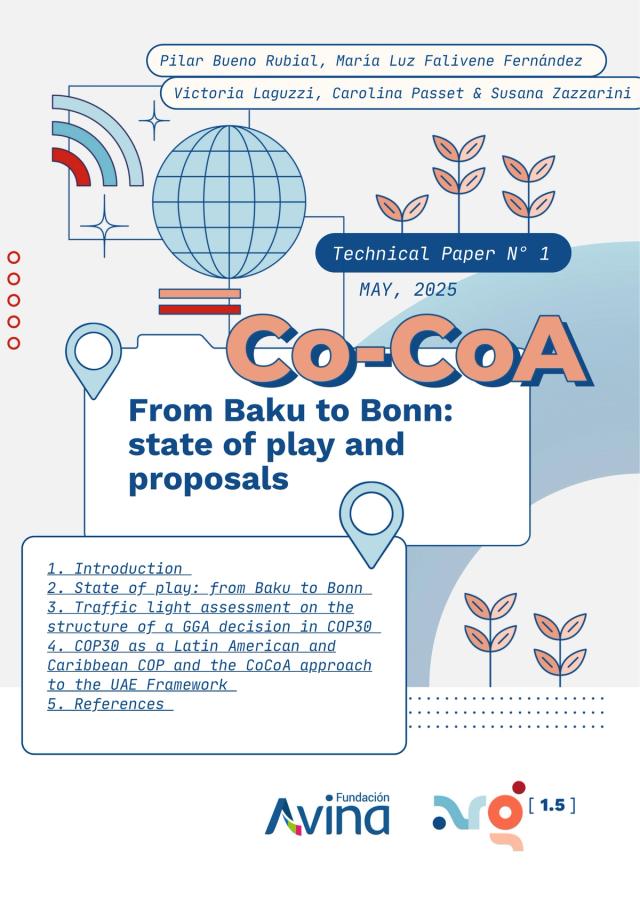
Co-CoA “Collective Construction of Adaptation Indicators” is a regional collaborative process established in 2024 by Argentina 1.5 and Fundación Avina, on climate adaptation methodologies and indicators that currently involves 42 organizations from Latin America and the Caribbean with the potential to contribute to the implementation of the United Arab Emirates Framework on Global Climate Resilience and its associated Monitoring, Evaluation and Learning system. The initiative seeks to strengthen the advocacy processes towards the implementation of the Global Goal on Adaptation (GGA) and the operationalization of its Framework. This technical paper, elaborated in the context of CoCoA, provides an update on key adaptation agenda items, along with a traffic light assessment of the structure of a GGA decision in COP30. It also includes a section focused on COP30 as a Latin American and Caribbean Conference.
From Baku to Bonn: state of play and proposals
Co-CoA “Collective Construction of Adaptation Indicators” is a regional collaborative process established in 2024 by Argentina 1.5 and Fundación Avina, on climate adaptation methodologies and indicators that currently involves 42 organizations from Latin America and the Caribbean with the potential to contribute to the implementation of the United Arab Emirates Framework on Global Climate Resilience and its associated Monitoring, Evaluation and Learning system. The initiative seeks to strengthen the advocacy processes towards the implementation of the Global Goal on Adaptation (GGA) and the operationalization of its Framework. This technical paper, elaborated in the context of CoCoA, provides an update on key adaptation agenda items, along with a traffic light assessment of the structure of a GGA decision in COP30. It also includes a section focused on COP30 as a Latin American and Caribbean Conference.