
Loading document…
Perspectives on the operationalization of the Santiago Network
Argentina 1.5ºC has prepared this synthesis report of the submissions presented by various actors to the United Nations Framework Convention on Climate Change regarding the implementation of the Santiago Network. The information is organized according to the main elements of the call for submissions under Decisions 19/CMA.3 and 17/CP.26: operational modalities; structure; the role of the Executive Committee of the Warsaw International Mechanism on Loss and Damage, its expert groups, task force, and technical groups; contact points for loss and damage and other key actors; and potential elements of the Network's Terms of Reference.
You may also be interested
GoGoGo to publications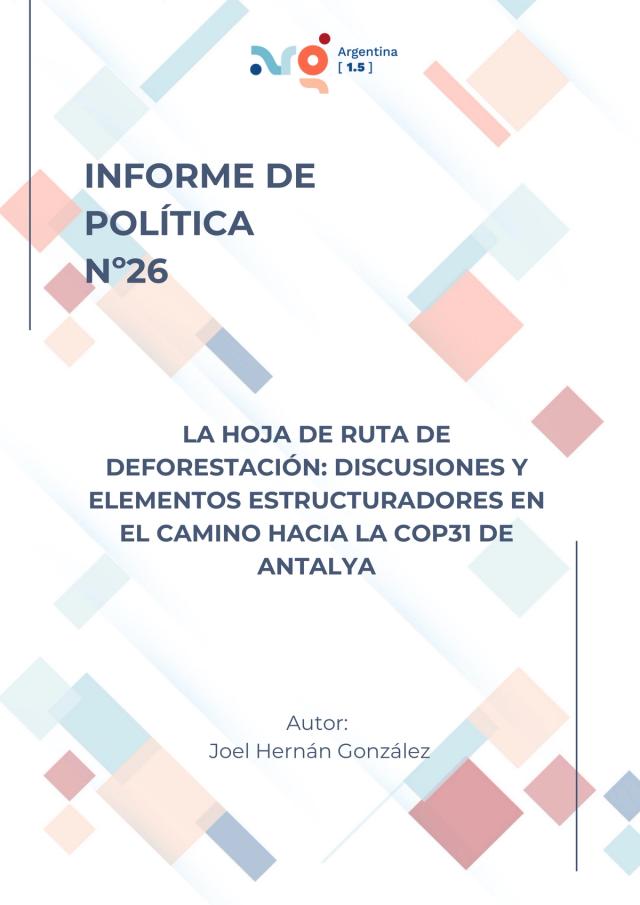
Deforestation Roadmap: discussions and structuring elements on the road to COP31 in Antalya
Forests provide essential ecosystem services for addressing the global environmental and climate crisis. Their capacity to store carbon, regulate hydrological cycles, stabilize regional temperatures, conserve biodiversity, and sustain the livelihoods of millions of people makes them a central component of international mitigation and adaptation strategies. Given their importance, forest management has gained increasing prominence on the international agenda. The most recent effort to revitalize this agenda is the Roadmap to Halt and Reverse Deforestation and Forest Degradation by 2030, launched by the COP30 Presidency in response to paragraphs 33 and 34 of the first Global Stocktake. This Policy Brief aims to briefly reconstruct the evolution of the forest agenda within the UNFCCC; examine the key features of the initiative; and highlight the main elements that emerged from the submissions and discussions held by the Parties. Finally, it is proposed to identify a series of barriers and recommendations associated with them, aimed at strengthening the Leaflet process on the way to the Conference of the Parties (COP31) of the UNFCCC that will take place in Antalya.
Deforestation Roadmap: discussions and structuring elements on the road to COP31 in Antalya
Forests provide essential ecosystem services for addressing the global environmental and climate crisis. Their capacity to store carbon, regulate hydrological cycles, stabilize regional temperatures, conserve biodiversity, and sustain the livelihoods of millions of people makes them a central component of international mitigation and adaptation strategies. Given their importance, forest management has gained increasing prominence on the international agenda. The most recent effort to revitalize this agenda is the Roadmap to Halt and Reverse Deforestation and Forest Degradation by 2030, launched by the COP30 Presidency in response to paragraphs 33 and 34 of the first Global Stocktake. This Policy Brief aims to briefly reconstruct the evolution of the forest agenda within the UNFCCC; examine the key features of the initiative; and highlight the main elements that emerged from the submissions and discussions held by the Parties. Finally, it is proposed to identify a series of barriers and recommendations associated with them, aimed at strengthening the Leaflet process on the way to the Conference of the Parties (COP31) of the UNFCCC that will take place in Antalya.
Submission by Task Force «Adaptation as a priority» and CANLA on the Baku Adaptation Roadmap
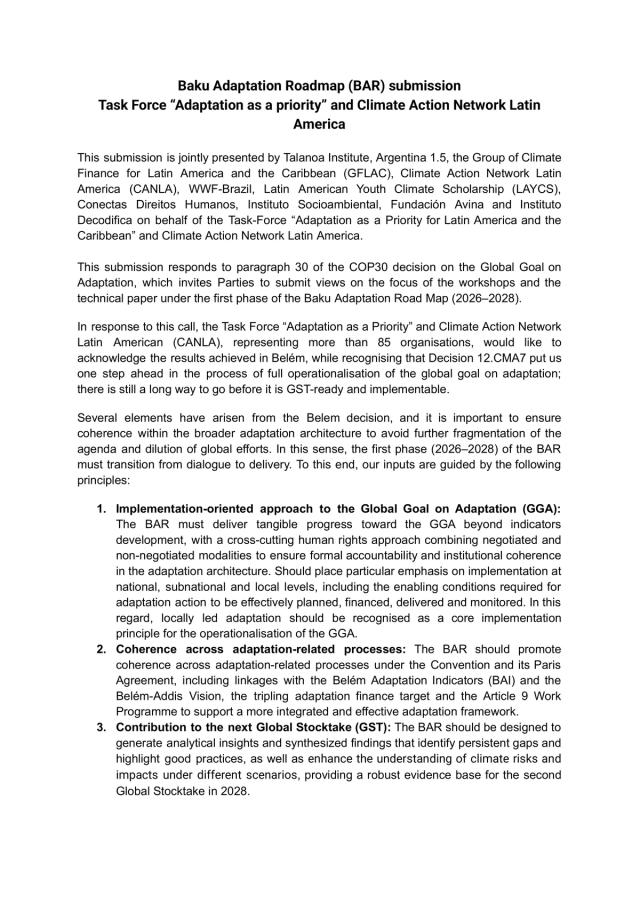
This submission is jointly presented by Talanoa Institute, Argentina 1.5, the Group of Climate Finance for Latin America and the Caribbean (GFLAC), Climate Action Network Latin America (CANLA), WWF-Brazil, Latin American Youth Climate Scholarship (LAYCS), Conectas Direitos Humanos, Instituto Socioambiental, Fundación Avina, and Instituto Decodifica on behalf of the Task-Force “Adaptation as a Priority for Latin America and the Caribbean” and Climate Action Network Latin America. This submission responds to paragraph 30 of the COP30 decision on the Global Goal on Adaptation, which invites Parties to submit views on the focus of the workshops and the technical paper under the first phase of the Baku Adaptation Road Map (2026–2028).
Submission by Task Force «Adaptation as a priority» and CANLA on the Baku Adaptation Roadmap
This submission is jointly presented by Talanoa Institute, Argentina 1.5, the Group of Climate Finance for Latin America and the Caribbean (GFLAC), Climate Action Network Latin America (CANLA), WWF-Brazil, Latin American Youth Climate Scholarship (LAYCS), Conectas Direitos Humanos, Instituto Socioambiental, Fundación Avina, and Instituto Decodifica on behalf of the Task-Force “Adaptation as a Priority for Latin America and the Caribbean” and Climate Action Network Latin America. This submission responds to paragraph 30 of the COP30 decision on the Global Goal on Adaptation, which invites Parties to submit views on the focus of the workshops and the technical paper under the first phase of the Baku Adaptation Road Map (2026–2028).
Argentina 1.5 submission on the COP30 Presidency Roadmap for Halting and Reversing Deforestation and Forest Degradation by 2030
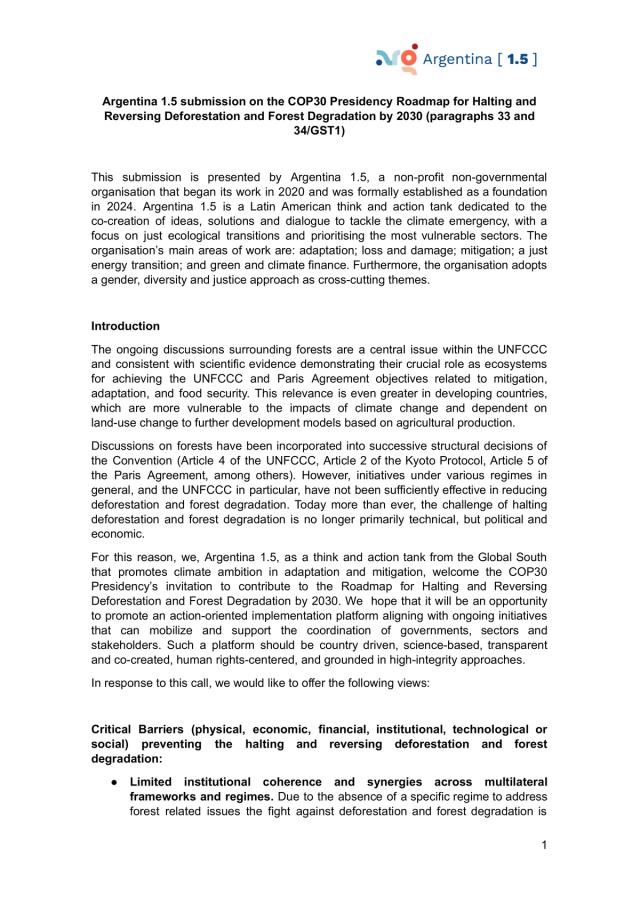
Argentina 1.5, as a think and action tank from the Global South that promotes climate ambition in adaptation and mitigation, welcomes the COP30 Presidency’s invitation to contribute to the Roadmap for Halting and Reversing Deforestation and Forest Degradation by 2030. We hope that it will be an opportunity to promote an action-oriented implementation platform aligning with ongoing initiatives that can mobilize and support the coordination of governments, sectors, and stakeholders. Such a platform should be country-driven, science-based, transparent and co-created, human rights-centered, and grounded in high-integrity approaches.
Argentina 1.5 submission on the COP30 Presidency Roadmap for Halting and Reversing Deforestation and Forest Degradation by 2030
Argentina 1.5, as a think and action tank from the Global South that promotes climate ambition in adaptation and mitigation, welcomes the COP30 Presidency’s invitation to contribute to the Roadmap for Halting and Reversing Deforestation and Forest Degradation by 2030. We hope that it will be an opportunity to promote an action-oriented implementation platform aligning with ongoing initiatives that can mobilize and support the coordination of governments, sectors, and stakeholders. Such a platform should be country-driven, science-based, transparent and co-created, human rights-centered, and grounded in high-integrity approaches.